IELTS Band Scores 2026 – Listening, Reading (Academic & GT), Writing & Speaking Score Tables
Understanding the IELTS Band Scores in 2026 By Yasir Saeed | IELTS Trainer & Founder, IELTSKaro | Updated: 2026 | Fact-checked against official IELTS, IDP, and British Council marking criteria The IELTS band scores is a scale upon which the IELTS tests its candidates. It is on a scale from 1 to 9, with each band
Table of contents
Understanding the IELTS Band Scores in 2026
By Yasir Saeed | IELTS Trainer & Founder, IELTSKaro | Updated: 2026 | Fact-checked against official IELTS, IDP, and British Council marking criteria
The IELTS band scores is a scale upon which the IELTS tests its candidates. It is on a scale from 1 to 9, with each band representing a specific level of English proficiency. This scale helps institutions and organizations understand a candidate’s ability to communicate effectively in English. The higher the band score, the higher the English level proficiency.
How the IELTS Band Scores are Calculated in 2026?
Each section of the IELTS—Listening, Reading, Writing, and Speaking—is scored separately. The individual scores are then averaged to produce an overall band score. It’s a precise system designed to provide a clear picture of a candidate’s strengths and weaknesses.
- Overall IELTS scores are always calculated to the nearest decimal. For example, if your band score comes out to be 6.75, then it will be rounded off to 7.0. Similarly, it comes out to 6.15, it will be rounded off to 6.
- My scores in Listening, Reading and Writing were 8.5 each, and in Speaking was a 7.5. The overall average was an 8.25, and it was rounded off to an 8.5. This shows that IELTS will automatically push you to the next band if your score is a perfect average.
- Your score will always round up or down to the nearest 0.5, as evident from the personal examples above.
Reading Band Scores – How is the Reading Band Score Calculated?
Similar to the listening test, each correct answer is worth one mark. The total correct answers are converted into a band score out of a total of 40 questions, reflecting your reading comprehension skills. Similar to the Listening Module, there is no negative marking.
Tips to Improve Reading Scores
- Read Widely: Explore different genres and topics to enhance your reading speed and understanding.
- Skim and Scan: Learn to quickly locate information and key details within texts.
- Practice with Timed Tests: Use practice tests to get accustomed to the exam’s timing and pressure.
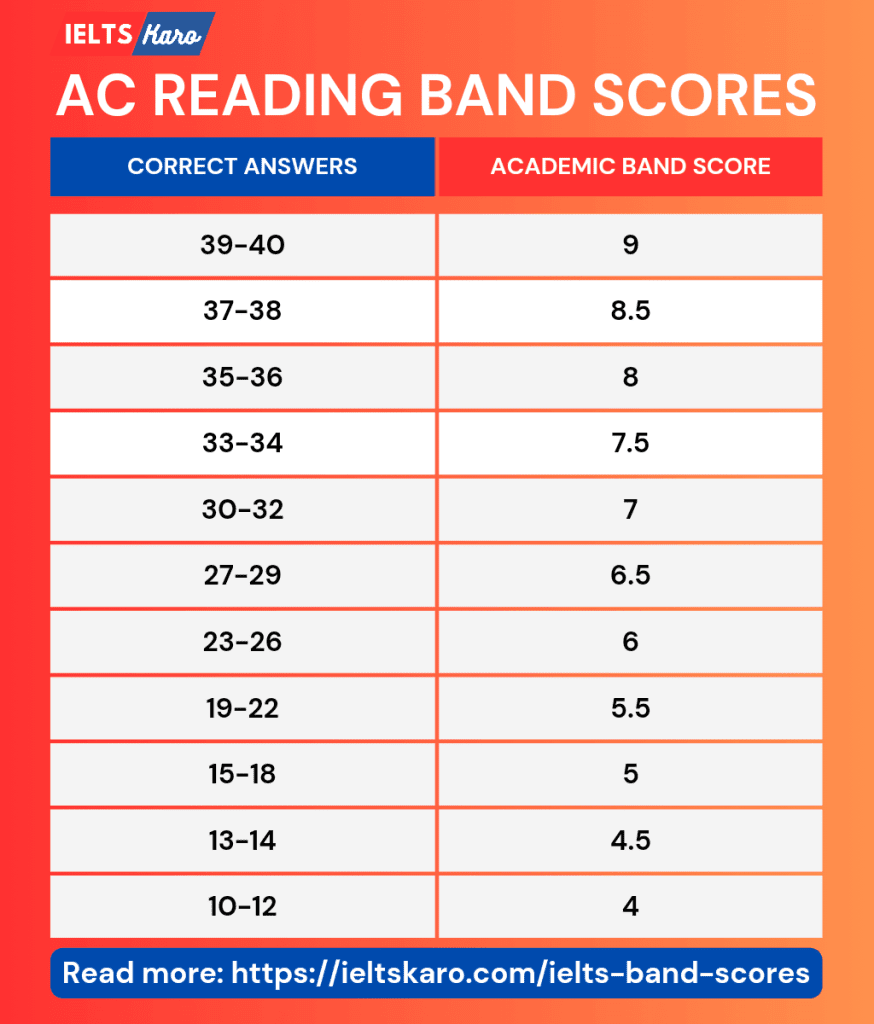
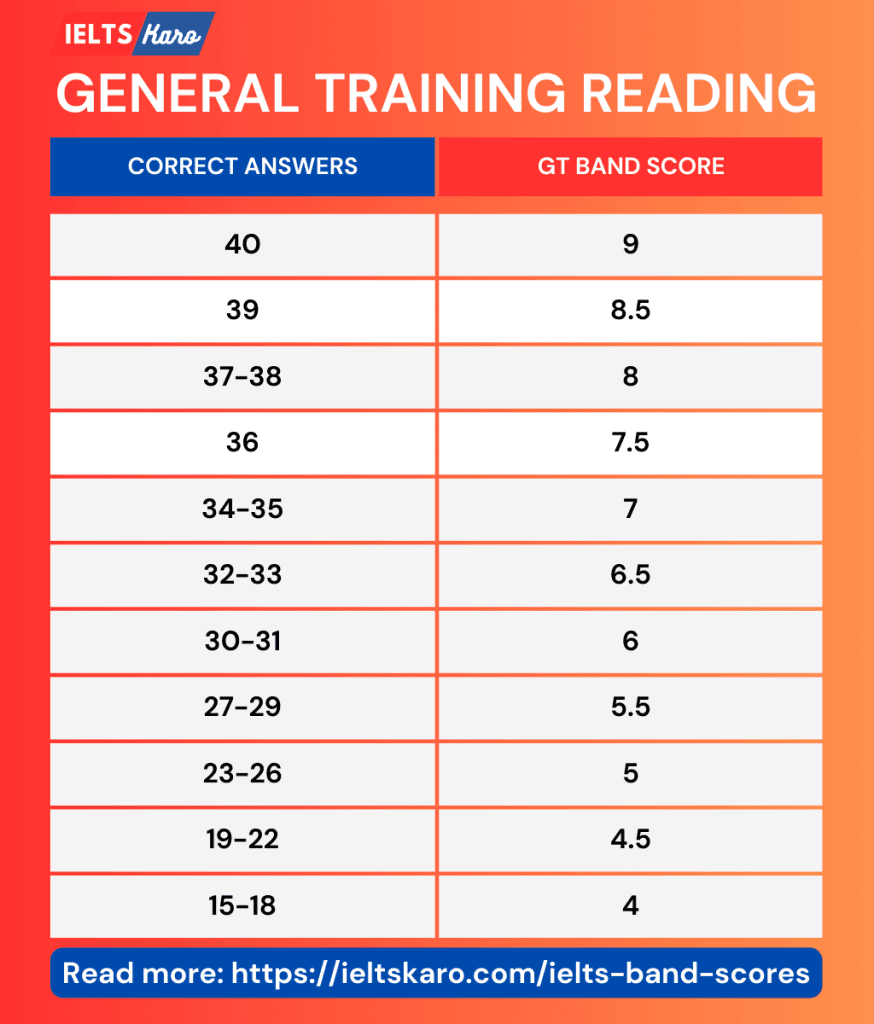
The table below shows the band scores based on the right answers from a total of 40 questions. There is a variation in the IELTS Academic and the IELTS General Training Reading modules. Hence, there is a difference in marking criteria.
While slightly more difficult, the Academic Reading has a relaxed marking criteria, giving you more room for a higher band score. Similarly, even though the General Training has easier reading passages as compared with the Academic Reading, the marking criteria is strict, which means you have less room in achieving a higher band score.
IELTS General Training Reading Score Chart – How Many Correct for Band 7?
| Correct Answers (out of 40) | Band Score |
| 40 | 9.0 |
| 39 | 8.5 |
| 37–38 | 8.0 |
| 36 | 7.5 |
| 34–35 | 7.0 |
| 32–33 | 6.5 |
| 30–31 | 6.0 |
| 27–29 | 5.5 |
| 23–26 | 5.0 |
| 19–22 | 4.5 |
IELTS Academic Reading Band Score Chart – How many Correct for Band 7?
| Correct Answers (out of 40) | Band Score |
| 39–40 | 9.0 |
| 37–38 | 8.5 |
| 35–36 | 8.0 |
| 33–34 | 7.5 |
| 30–32 | 7.0 |
| 27–29 | 6.5 |
| 23–26 | 6.0 |
| 19–22 | 5.5 |
| 15–18 | 5.0 |
And here is the downloadable Academic Reading Band Score chart:
Here is the downloadable GT Reading Band Score Table:
You can use our FREE IELTS Band Score Calculator to calculate your bands.
The band scores for Speaking and Writing have a different criteria. Here are some links to speaking and writing marking criteria that will give you a clearer picture of how the examiners assess and mark writing and speaking:
Listening Band Scores
How is the Listening Band Score Calculated?
Each correct answer in the listening test is awarded one mark, and the total number of correct answers is converted into a band score. This ensures a standardized measure of your listening skills. There is no negative marking. IELTS Listening marking criteria is the same for Academic and General tests. Unlike reading, you just need a minimum of 30 out of 40 correct answers to achieve a 7.0
Tips to Improve Listening Scores
- Practice Regularly: Listen to English podcasts, watch movies, and engage in conversations.
- Take Notes: Develop your note-taking skills to capture key points quickly.
- Understand Accents: Familiarize yourself with various English accents to improve comprehension.
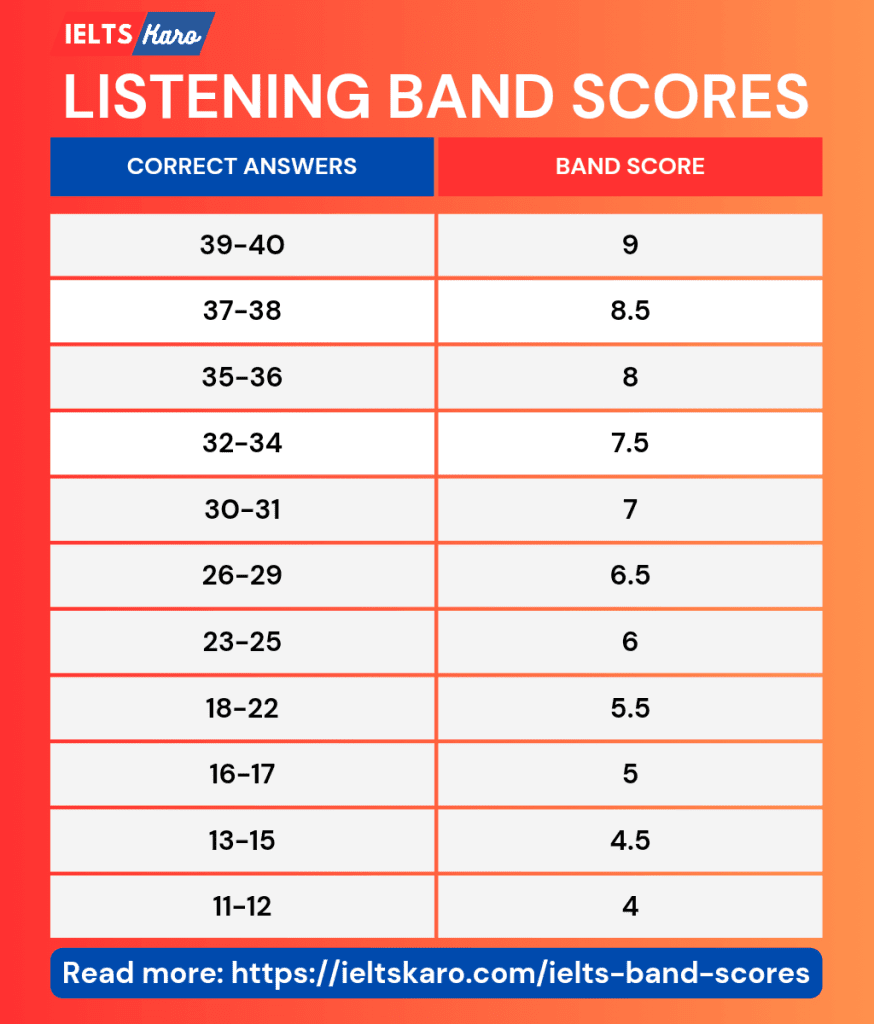
The table below highlights the band scores at each level of correct answers. Your band scores are calculated based on the correct answers out of 40 questions. The marking criteria for Listening GT and Academic is the same. Here is the table:
IELTS Listening Band Score Chart
| Correct Answers (out of 40) | Band Score |
| 39–40 | 9.0 |
| 37–38 | 8.5 |
| 35–36 | 8.0 |
| 32–34 | 7.5 |
| 30–31 | 7.0 |
| 26–29 | 6.5 |
| 23–25 | 6.0 |
| 18–22 | 5.5 |
| 16–17 | 5.0 |
Here is a downloadable chart:
Writing Band Scores
How is the Writing Band Score Calculated?
Examiners assess your writing based on four criteria: task achievement, coherence and cohesion, lexical resource, and grammatical range and accuracy. Each criterion contributes to your overall writing band score and each is worth 25% of the marking criteria, thereby making it 100% of your writing score. Each one of these criteria is scored individually on a band scale from 1 to 9, and then averaged out for both writing tasks.
There is no table that can easily explain how the writing band score is calculated because there are no questions unlike Reading and Listening. It is all about how well-organized, well-written, well-structured, and to-the-point your content is. The higher the quality of your written content, the higher would be the band score!
Tips to Improve Writing Scores
- Plan Your Essays: Spend time planning before you start writing to ensure a clear structure.
- Expand Your Vocabulary: Use a wide range of vocabulary appropriately to enhance your writing.
- Practice Regularly: Write essays and get feedback to continually improve your skills.
Writing and Speaking IELTS Vocabulary List
- Cities, Transport and Urban Life 100+ Words
- Environment 50+ words for pollution, climate, sustainability, conservation
- Health & Fitness Words for healthcare, medicine, wellbeing, mental health, lifestyle
- Family & Society Relationships, parenting, generations, social structures
- Education Schools, universities, learning, academic performance, skills
- Work & Employment Careers, workplace, unemployment, skills, remote work
- Technology & AI Digital tools, social media, AI, automation, innovation
- Crime & Punishment Law enforcement, offences, justice, rehabilitation
- Government & Politics Policy, governance, democracy, public services
- Food & Diet Nutrition, eating habits, food culture, diet trends
- Advertising & Marketing Persuasion, branding, consumer behaviour, media
- Body Language Non-verbal communication, gestures, expression
- Films & Media Cinema, storytelling, genres, cultural impact
Speaking Band Scores
How Speaking is Scored
Examiners score the speaking test based on fluency and coherence, lexical resource, grammatical range and accuracy, and pronunciation.
Tips to Improve Speaking Scores
- Practice Speaking: Engage in conversations in English as much as possible.
- Record Yourself: Listen to your recordings to identify areas for improvement.
- Expand Your Vocabulary: Use a variety of words and phrases to express your ideas clearly.
Speaking Topics Part 1, 2 and 3 Resources
- Has the IELTS Speaking Test Pattern Changed?
- IELTS Speaking Topics 2026 Part 1, 2 and 3 with Answers
- Which part is the most important in speaking?
- Speaking Part 1 Topics
- Speaking Part 2 Cue Card Topics
- Speaking Part 3 Topics
Overall IELTS Band Score – What Score Do You Need?
| Goal | Minimum IELTS | Competitive Score | Full Guide |
|---|---|---|---|
| Canada PR (Express Entry) | 6.0 all components | 8.0 L / 7.0 R / 7.0 W / 7.0 S | IELTS Score for Canada PR Express Entry |
| Canada Student Visa | 6.0 overall | 6.5 overall | IELTS Score for Canada Student Visa |
| UK Student Visa | 5.5 all components | 6.5 to 7.0 | IELTS Score for UK Student Visa |
| Australia PR | 6.0 all components | 7.0 for bonus points | IELTS Score for Australia PR |
How Overall Band Scores are Calculated
Your overall band score is the average of your four individual scores, rounded to the nearest whole or half band. For example, if your scores are 7.5, 8.0, 6.5, and 7.0, your overall band score would be 7.25, which rounds up to 7.5.
What Overall Band Scores Mean
Each overall band score corresponds to a level of English proficiency, from non-user (band 1) to expert (band 9). This score gives a comprehensive view of your ability to use and understand English in various contexts.
Interpreting Your Band Scores
What Each Band Score Represents
- Band 1: Non-user
- Band 2: Intermittent user
- Band 3: Extremely limited user
- Band 4: Limited user
- Band 5: Modest user
- Band 6: Competent user
- Band 7: Good user
- Band 8: Very good user
- Band 9: Expert user
Band Score Descriptors
Each band score comes with detailed descriptors that explain what a candidate can do at that level, providing a clear benchmark for skills and abilities.
IELTS Score Requirements
Academic vs. General Training Requirements
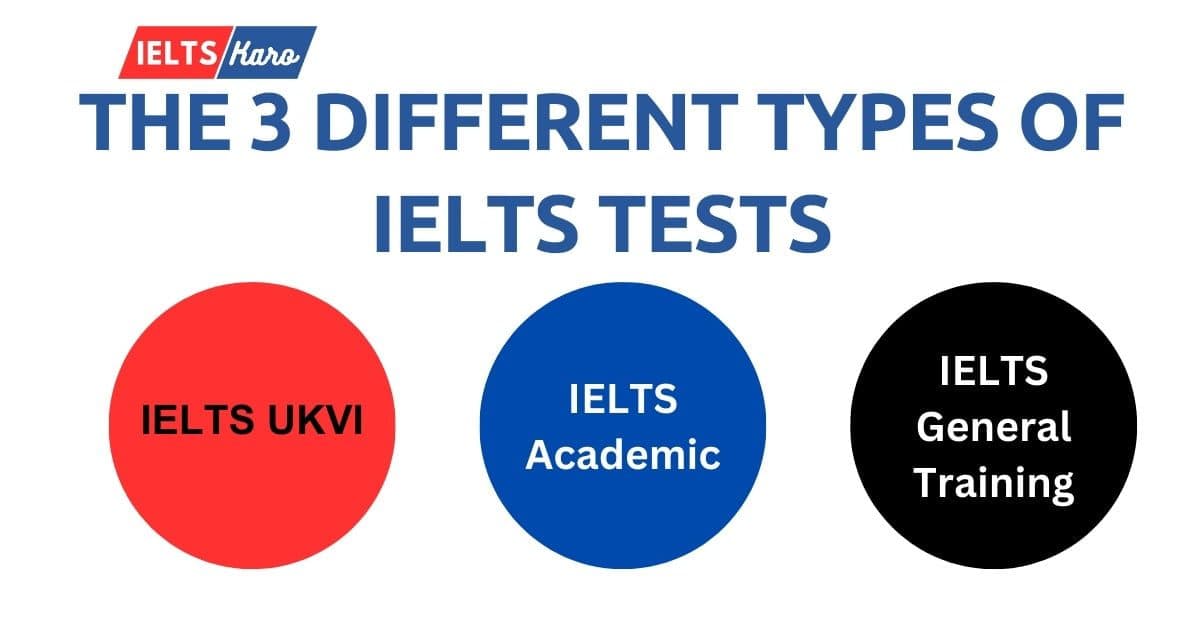
The IELTS offers two versions: Academic and General Training. The Academic version is typically required for higher education and professional registration, while the General Training version is for those migrating to an English-speaking country or applying for secondary education.
Score Requirements for Universities and Employers
Different institutions and employers have varying score requirements. It’s crucial to check the specific requirements of the organization you’re applying to. Generally, top universities may require a score of 7.0 or higher.
Common Misconceptions about IELTS Scores
Myths about the Band Scale
There are several myths about IELTS scores, such as needing a perfect 9 in all sections to succeed. In reality, requirements vary widely depending on your goals.
Clarifying Common Confusions
It’s important to understand that the IELTS is a measure of overall proficiency, not perfection. Even native speakers may not achieve a perfect score in every section.
Improving Your IELTS Band Score
Study Strategies
Effective study strategies include setting realistic goals, focusing on weaker areas, and using varied resources to keep learning interesting and engaging.
Practice Tests and Resources
Utilize practice tests to familiarize yourself with the test format and identify areas for improvement. There are many online resources available, including official IELTS materials.
Time Management Tips
Time management is crucial during the IELTS test. Practice managing your time effectively during preparation to avoid running out of time during the actual test.
IELTS Preparation Courses
Benefits of Preparation Courses
Preparation courses offer structured learning, expert guidance, and regular feedback, which can significantly improve your band score.
Choosing the Right Course
When selecting a course, consider factors like the reputation of the institution, the experience of the instructors, and the feedback from past students.
Self-Study Tips for IELTS
Creating a Study Plan
A well-structured study plan helps keep your preparation on track. Allocate specific times for each section of the test and stick to your schedule.
Planning to Move to Canada?
Your IELTS band score isn’t just a number—it’s CRS points that determine your entire Express Entry timeline.
Quick Reality Check:
- Band 6.0 (CLB 7) = Minimum eligible = 68 language points
- Band 7.0+ (CLB 9) = Competitive = 124 language points
- That’s 56 points difference from improving just 1 band level
And those 56 points? They could mean getting your ITA in 3 months versus waiting 2 years.
Not sure what score you need? Read our complete guide on What is a Good IELTS Score for Canada Express Entry?
We break down the exact IELTS bands required for your profile, how CLB conversion works, and how to calculate your CRS score accurately.
Further Guides and Preparation Material:
- What is a Good IELTS Score for Canada Express Entry?
- What is the minimum IELTS score for UK Student Visa?
- What is the minimum IELTS score required for Canada Student Visa?
- How to Show Proof of Funds for Australia, UK and Canada?
- IELTS Speaking Topics 2026 with Answers
- A complete list of vocabulary to use in your exam
Utilizing Online Resources
There are numerous online resources available, from practice tests to instructional videos. Use these to complement your study plan and gain different perspectives on test strategies. We offer AI-Powered instant feedback for all modules including speaking and writing that you can check out at app.ieltskaro.com
Dealing with Test Anxiety
Techniques such as deep breathing, visualization, and mindfulness can help manage test anxiety. It’s also important to stay positive and confident.
Ensure you get adequate rest and maintain a healthy diet, especially as the test date approaches. A well-rested mind performs better under pressure.
Conclusion
Preparing for the IELTS can be a daunting task, but understanding the band scores and how they are calculated can make the process easier. Focus on improving your skills in each section, utilize available resources, and practice consistently. Remember, achieving your desired band score is within reach with the right preparation and mindset.
FAQs
How many correct answers for IELTS Band 7.0
To get a 7.0 in Listening or Academic Reading, you need 30/40 correct answers. For General Training Reading, you need 34-35. Use the conversion tables to see exactly where you stand for 2026.
How long are IELTS scores valid?
IELTS scores are valid for two years from the date of the test.
Can I retake the IELTS test if I’m not satisfied with my score?
Yes, you can retake the IELTS test as many times as you wish. However, it’s advisable to prepare thoroughly before each attempt.
How soon can I retake the IELTS test?
You can retake the IELTS test whenever you feel ready. There are no restrictions on the number of attempts or the time between attempts.
Do all institutions accept both Academic and General Training IELTS scores?
No, institutions usually specify which version of the IELTS they require. It’s important to check their specific requirements before applying.
How can I verify the authenticity of my IELTS score?
You can verify your IELTS score by using the TRF (Test Report Form) number on the official IELTS website.
Is the IELTS score chart different for Academic and General Training?
Yes. While Listening is the same for both, the Reading charts differ. General Training is “easier,” so you need more correct answers (raw marks) to get the same band score as Academic.
How is the overall IELTS Band Score rounded?
IELTS averages your 4 scores and rounds to the nearest 0.5. If your average ends in .25, it rounds up to .5. If it ends in .75, it rounds up to the next whole number. (e.g., 6.75 = 7.0).
Can I predict my IELTS score with AI?
Yes. You can use the IELTSkaro AI Speaking Agent to get an instant band score prediction based on the official 2026 descriptors. It also helps you to get an instant feedback for writing as well as all other modules.
| Yasir Saeed IELTS Trainer | Founder, IELTSKaro | IELTS Overall: 8.5 I am Yasir, an IELTS trainer and digital educator with over a decade of experience in content, communication coaching, and EdTech. My IELTS band score is 8.5 and I am genuinely interested in helping you to get your desired band score. I am also the founder of IELTSKaro, backed by Google for Startups and ElevenLabs helping you with smart, AI-powered, instant feedback, alongside live classes. |
ieltskaro.com | IELTS Band Score Complete Guide with Calculator — 2026 | Updated 2026
Your friendly IELTS instructor, and the owner of IELTSKaro.com. The word "Karo" means to "do it", thereby our website is enabling students to study and appear for IELTS. IELTSkaro, bahir niklo.