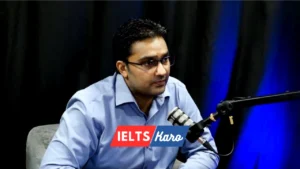

By Yasir Saeed | IELTS Trainer & Co-founder, IELTSKaro | IELTS Speaking: 8.0 | Updated: 2026
Of the three parts of the IELTS Speaking test, Part 2 is the one that scares candidates the most. Speaking for two uninterrupted minutes on a topic you have never seen before, with only one minute to prepare, sounds daunting.
But here is the truth: With an 8.0 in Speaking, I can tell you with my own experience that Part 2 is actually the most controllable section of the entire Speaking test, because it follows a completely predictable format every single time.
In this guide, you will get a full breakdown of:
- How Part 2 works?
- Step-by-step note-taking technique for your one preparation minute
- 6 complete cue card topics with Band 7–8 sample responses and examiner commentary
- A common cue card topic list
- And the specific strategies that keep candidates speaking fluently for the full two minutes.
What is IELTS Speaking Part 2?
IELTS Speaking Part 2 commonly called the ‘long turn’ or ‘cue card’ section follows immediately after Part 1. The examiner gives you a printed card with a topic and three or four bullet points. You have exactly one minute to prepare, then you must speak for between one and two minutes without being interrupted.
Here is the exact sequence of events:
- Examiner hands you the cue card and a pencil and paper for notes.
- You have exactly 1 minute to prepare. Use every second of it.
- The examiner says ‘Please start speaking now.’
- You speak for 1 to 2 minutes. The examiner will stop you at the 2-minute mark if you are still speaking.
- The examiner asks 1 or 2 brief follow-up questions directly related to your cue card topic before moving to Part 3.
| ℹ️ The minimum vs the target Speaking for exactly 1 minute will not earn you a penalty, but it will cost you marks. A 1-minute response gives the examiner very little evidence to assess your fluency, vocabulary range, and grammatical complexity. The target is always the full 2 minutes. Every strategy in this guide is designed to help you fill that time naturally. |
What Does Your Part 2 Response Sound Like at Each Band?
Understanding what examiners are listening for at each band level is the fastest way to identify where you currently are and what you need to improve.
| Band | What your Part 2 response looks like at this level |
| Band 9 | Speaks for the full 2 minutes without prompting. Response is fully coherent, uses a wide range of vocabulary and grammar naturally, pronunciation is clear with no strain on the listener. |
| Band 8 | Speaks fluently for 2 minutes with only occasional minor hesitation. Vocabulary is varied and precise, grammar is mostly complex and accurate, minor slips do not affect communication. |
| Band 7 | Speaks for 1.5–2 minutes with some hesitation. Good range of vocabulary, uses some complex structures, generally clear. May lose coherence slightly toward the end. |
| Band 6 | Reaches 1 minute but may struggle to fill 2 minutes. Vocabulary is adequate but repetitive, grammar is mostly simple, some errors that cause occasional misunderstanding. |
| Band 5 | Often stops before 2 minutes. Limited vocabulary, repetitive structures, frequent pauses. May stray from the topic or give very short, undeveloped answers. |
The 1-Minute Preparation Technique (Step by Step)
Most candidates waste their preparation minute either staring at the card or trying to write full sentences. Both approaches hurt your response. Here is the correct technique:
Step 1: Read the entire card first (10 seconds)
Read the main topic and all the bullet points before writing anything. This gives you a mental map of the whole response before you start planning any part of it.
Step 2: Write only keywords against each bullet point (35 seconds)
You do not have time for full sentences. Write 2–3 keywords or short phrases per bullet point, just enough to trigger your memory when you are speaking. Think of it as building a signpost, not a script.
| ⚠️ What to write For the bullet ‘When you first tried it’, write: ‘school, age 12, friend’s house’. That is enough. When you are speaking, those three words will unlock the memory and the language will follow naturally. Full sentences on your notes are a trap — you will read them out robotically, which destroys fluency. |
Step 3: Add one personal detail or story (10 seconds)
The single most effective way to fill two minutes naturally is to have one personal anecdote or specific memory attached to the topic. In your last few seconds of prep, identify it. Something like: ‘first time I tried this, funny moment, a specific person I associate with this topic’.
Step 4: Plan your closing sentence (5 seconds)
Many candidates trail off or repeat themselves in the final 30 seconds. Prepare a closing thought in advance: a recommendation, a reflection, or a statement about why the topic matters to you personally. This gives your response a natural ending instead of an awkward fade.
Cue Card 1: Describe a Person
| 📋 Cue Card Topic Describe a person who has had a significant influence on your life. You should say: who this person is and your relationship with them what qualities this person has how they have influenced you and explain why you admire them You will have 1 minute to prepare. You may make notes. |
| Sample 1-Minute Preparation Notes Who / relationship University professor final year Subject: marketing & communication Their qualities Patient, sharp, always challenged you to think differently Never gave answers, asked better questions How influenced me Changed how I approach problem-solving First person to tell me I should write, led to content work Why I admire them Humble despite being the most knowledgeable person in the room Still in touch, still learn from him |
| Sample Response. Band 7–8 The person I would like to talk about is a university professor I had in my final year of study. His name was Professor Arshad Javed, and he taught marketing and communication, which, looking back, was probably the most formative course I took in my entire degree. What made him stand out from every other teacher I had was his approach to questions. Most lecturers give you the answer. He would ask you a better question instead. You would walk into his class thinking you understood something, and walk out realising you had only scratched the surface. That approach on deeper thinking completely changed how I approach problems, both professionally and personally. In terms of influence, he was the first person who told me directly that I should pursue writing and communication as a career. I was not particularly confident in that area at the time, but his feedback was so specific and genuine that I actually believed him. Everything I have built in content creation and education since then can be traced back to that one conversation. What I admire most about him is his humility. He was easily the sharpest person in the room at any given time, and yet he never made you feel small for not knowing something. That combination of brilliance and warmth is rare, and I still aspire to it. Examiner Notes Strong opening that immediately introduces the person with context, no filler or repetition. Paragraph 2 uses an effective contrast (‘most lecturers… Professor…’) , shows grammatical range and coherence. Personal impact is specific and credible, not generic (‘he changed my life’) but traceable. Final paragraph uses sophisticated vocabulary: ‘humility’, ‘aspire to’, ‘brilliance and warmth’. Response runs close to 2 minutes at natural speaking pace. Well-structured throughout. |
Cue Card 2: Describe a Place
| 📋 Cue Card Topic Describe a place you have visited that made a strong impression on you. You should say: where the place is what you did there what made it memorable or special and explain how you felt while you were there You will have 1 minute to prepare. You may make notes. |
| Sample 1-Minute Preparation Notes Where Lahore, Walled City / Old Lahore Visited properly for the first time 2 years ago (grew up here but never explored it) What I did Walked through the food street near Anarkali Visited the Lahore Fort and Badshahi Mosque What made it memorable Contrast, centuries-old architecture next to modern cafes The energy, different from anywhere else in the city How I felt Struck by how much history I had been ignoring in my own city Proud, curious, slightly ashamed I had never explored it properly |
| Sample Response. Band 7–8 The place I want to describe is actually somewhere I have lived my whole life but only properly explored a couple of years ago, the Walled City of Lahore. It sounds strange to visit your own hometown as though it were a tourist destination, but that is exactly what I did, and it completely changed how I see the city. I spent an afternoon walking through the old streets near Anarkali, stopping at food stalls that have apparently been there for generations, and then visited the Lahore Fort and the Badshahi Mosque. I had seen photographs of both all my life, but being there in person, understanding the scale of them is a completely different experience. What made it so memorable was the contrast. You turn a corner and there is a Mughal-era gateway that is four hundred years old, and immediately next to it is a modern coffee shop with people working on laptops. That collision of centuries in one physical space is something I had not expected and have not forgotten. As for how I felt, honestly, a mixture of pride and something close to guilt. Pride because this extraordinary place exists in my city. And guilt because I had lived here my entire life without giving it the attention it deserved. I came home that day feeling like I had just discovered something enormous that had been sitting right in front of me all along. Examiner Notes Unconventional angle, exploring your own city as a tourist, makes the response distinctive and memorable. ‘It sounds strange to visit your own hometown as though it were a tourist destination’, natural, idiomatic expression. Paragraph 3 uses effective contrasting structure. Mughal gateway vs modern coffee shop. Emotional range in the closing paragraph (‘pride and something close to guilt’) sophisticated vocabulary and nuanced expression. Approximately 240 words, a strong 2-minute response. |
Cue Card 3: Describe an Object
| 📋 Cue Card Topic Describe an object that is important to you. You should say: what the object is how long you have had it why it is important or meaningful to you and explain how you would feel if you lost it You will have 1 minute to prepare. You may make notes. |
| Sample 1-Minute Preparation Notes What it is My first laptop, an old second hand Dell, given to me by a relative Still have it, doesn’t work properly anymore How long About 10 years Why important Wrote my first real work on it, first articles, first freelance projects Represents the start of everything I have built professionally If I lost it Emotionally significant. It’s not about the device, it’s about what it represents Like losing a chapter of your life |
| Sample Response. Band 7–8 The object I want to describe is my first laptop, an old secondhand Dell, a battered and worn out laptop that a relative gave me about ten years ago. It barely works now. The battery life is about twelve minutes and the fan makes a noise that sounds like a small aircraft taking off. But I still have it, and I probably always will. I received it at a time when I did not have much, and having my own computer felt like being given access to an entirely different world. I spent the first few weeks just exploring what it could do. And then I started writing. Everything I have built professionally, my first articles, my first freelance projects, the ideas that eventually became my current work in education and content, was started on that machine. So the object itself is just a worn-out laptop, but what it represents is the beginning of a career. That is difficult to separate from the physical object, even when the object no longer functions. If I lost it, I do not think I would be upset about the laptop specifically. I would be upset about losing something that represents a chapter of my life that I cannot get back. There is a difference between losing something useful and losing something that has meaning, and this falls very firmly into the second category. Examiner Notes Vivid, humorous detail in paragraph 1 (‘fan sounds like a small aircraft’), immediately engaging, natural storytelling. Paragraph 3 contains sophisticated reflection, distinguishes between the object and what it represents. Final paragraph uses complex grammatical structure and nuanced philosophical distinction. Consistent, natural tone, sounds genuine rather than rehearsed. Range of vocabulary: ‘battered’, ‘worn-out’, ‘firmly into the second category’. |
Cue Card 4: Describe an Event
| 📋 Cue Card Topic Describe an event you attended that you found particularly memorable. You should say: what the event was and where it took placewho you were withwhat happened during the eventand explain why it was memorable for you You will have 1 minute to prepare. You may make notes. |
| ✍️ Sample 1-Minute Preparation Notes What / where A startup networking event — held at a university campusFirst event I attended as a co-founder, not as an employee Who with Co-founder Abubakar — first public outing for IELTSKaro What happened Pitched the idea to strangers for the first timeGot much better feedback than expectedSomeone asked for the website — we barely had one Why memorable First time the business felt real, not just an idea we talked aboutShift in identity — entrepreneur, not just employee |
| 🎤 Sample Response — Band 7–8 The event I want to talk about is a startup networking evening I attended about two years ago at a university campus in Lahore. On paper it was a fairly ordinary event — a hall full of entrepreneurs and investors exchanging business cards and pitching ideas. But for me personally, it was a turning point. I was there with my co-founder, and it was the first time we had attended any public event as a company rather than as individuals. We had been building our platform for a while, but it had mostly existed inside our laptops and in conversations between the two of us. That evening, we talked about it to strangers for the first time. What I remember most clearly is describing the idea to someone I had never met, watching their expression shift from polite attention to genuine interest, and then having them ask for our website. We barely had one. That gap between where we were and where we needed to be suddenly became very real and very motivating, all at the same time. It was memorable because it was the first moment the business stopped feeling like something we were going to do and started feeling like something we were actually doing. That shift in identity — from someone with an idea to someone building something — happened at that event, and I have not thought about myself in the same way since. ✔ Examiner Notes • Strong contextual opening that builds tension (‘on paper… but for me personally’) — sophisticated cohesive device. • Specific, credible detail (‘they asked for our website, we barely had one’) — far more compelling than generic descriptions. • Paragraph 4 contains an excellent reflection on identity shift — high-level abstract thinking expressed clearly. • Vocabulary: ‘turning point’, ‘shift in identity’, ‘polite attention to genuine interest’. • Personal and authentic — zero indication of memorisation. |
Cue Card 5: Describe a Skill or Activity
| 📋 Cue Card Topic Describe a skill you would like to learn or improve. You should say: what the skill iswhy you want to learn or improve ithow you plan to develop itand explain how it would benefit your life or work You will have 1 minute to prepare. You may make notes. |
| ✍️ Sample 1-Minute Preparation Notes What skill Public speaking / presenting to large audiencesComfortable one-on-one or small groups, but not at scale Why learn it Work in education and content — presentations are essentialWant to run workshops, speak at events How to develop Join a local Toastmasters groupCreate more video content — forces exposure to cameraPractise with IELTSKaro students first — safe environment How it would benefit Reach more people with less effortOpens doors to speaking at conferences, universities |
| 🎤 Sample Response — Band 7–8 The skill I would most like to improve is public speaking — specifically, the ability to present confidently to large audiences. This might seem like an odd answer for someone who works in education and content, but there is an important distinction between being comfortable speaking to small groups and being genuinely effective in front of a hundred people. I can hold a room in a conversation, and I am reasonably confident on camera. But the moment I imagine standing on a stage in front of a large audience, there is a hesitation there that I have not yet fully resolved. I know it is something I need to address because the work I do — teaching, building a platform, representing a company — is increasingly heading in that direction. In terms of how I plan to develop it, I have been looking at joining a Toastmasters group, which is specifically designed to build public speaking skills in a supportive environment. I also think continuing to produce video content is helping — every time you press record, you are practising the discipline of speaking clearly without the safety net of being able to stop and restart. The benefit would be significant. Public speaking is essentially a force multiplier — one well-delivered presentation can reach more people in forty minutes than months of one-on-one interactions. Developing that skill would open doors to university workshops, industry conferences, and a much wider audience for what I am building. ✔ Examiner Notes • Honest, self-aware opening — ‘this might seem like an odd answer’ immediately creates interest. • ‘There is a hesitation there that I have not yet fully resolved’ — sophisticated, authentic self-reflection. • Specific plan (Toastmasters, video content) makes the response credible rather than theoretical. • ‘Force multiplier’ in closing paragraph — precise, professional vocabulary that shows strong Lexical Resource. • Response is personal and specific — no risk of sounding like a memorised answer. |
Cue Card 6: Describe a Book, Film or TV Programme
| 📋 Cue Card Topic Describe a book, film or TV programme that had a strong impact on you. You should say: what it was and what it was aboutwhen you read or watched ithow it affected or changed youand explain why you would recommend it to others You will have 1 minute to prepare. You may make notes. |
| ✍️ Sample 1-Minute Preparation Notes What it was Book: ‘Shoe Dog’ by Phil Knight (founder of Nike)Memoir / business story — building Nike from scratch When Read it during a difficult period of building IELTSKaroAround 2 years into the startup How it affected me Normalised struggle — Knight failed constantly before succeedingMade me stop expecting the path to be straight Why recommend Not a ‘motivational’ book — honest about failureBest antidote to the highlight-reel version of entrepreneurship |
| 🎤 Sample Response — Band 7–8 The book I want to talk about is ‘Shoe Dog’ by Phil Knight, which is the memoir of the founder of Nike. I read it about two years into building my own startup, during a period that was frankly quite difficult, and it hit me at exactly the right moment. The book is not what you might expect from a business memoir. It is not a collection of success stories and motivational lessons. It is an honest, sometimes brutal account of how close Nike came to failing — repeatedly — over its first fifteen years. Knight describes being on the verge of bankruptcy multiple times, relationships straining under pressure, and decisions made with incomplete information. It reads like a survival story as much as a success story. The impact on me was specific: it normalised struggle. Before reading it, I had a tendency to interpret difficulty as evidence that something was going wrong. After reading it, I started to see difficulty as evidence that something real was happening. That shift in perspective sounds small, but it changed how I responded to setbacks on a day-to-day basis. I would recommend it to anyone building something — not because it will make you feel motivated, but because it will make you feel less alone. Most of what gets shared publicly about entrepreneurship is the highlight reel. This book is the opposite of that, and it is far more useful. ✔ Examiner Notes • Specific book with personal timing context (‘two years into building my startup, during a difficult period’) — immediately authentic. • Paragraph 2 subverts expectations (‘not what you might expect’) — a sophisticated rhetorical technique. • The distinction between ‘evidence that something was going wrong’ and ‘evidence that something real was happening’ — genuinely insightful and articulate. • Closing paragraph uses ‘highlight reel’ metaphorically — contemporary, natural expression that examiners find refreshing. • Zero signs of memorisation — deeply personal and specific throughout. |
Common IELTS Cue Card Topics: 2025 Reference List
The IELTS cue card topic bank rotates, but certain categories appear consistently. Here are the main categories and example topics to practise with:
| Category | Common example topics |
| People | A person who influenced you / A person you admire / A family member who inspires you / A teacher or mentor |
| Places | A place you want to visit / Your hometown / A historical site / A place you visit to relax / A place from childhood |
| Objects | A gift you gave or received / Something you cannot live without / A childhood possession / A useful piece of technology |
| Events | A celebration / A sporting event / An achievement / A time you helped someone / A challenging experience |
| Activities | A hobby / A sport / A skill you want to learn / Something you do to relax / A type of exercise |
| Media | A book / A film / A TV programme / A song / A news story that affected you / An advertisement you remember |
| Social | A piece of advice you received / A time you were late / A time you forgot something important / A rule you disagree with |
| Nature | An animal / A type of weather / A natural disaster / A season / An environmental issue |
| ⚠️ How to practise Pick one topic from the table above every day. Set a 1-minute timer, write your notes (keywords only). Set a 2-minute timer, speak your full response aloud. Record yourself. Listen back. Repeat. Do this for 2 weeks before your test and Part 2 will no longer feel like the hardest section. |
Frequently Asked Questions
Q: Do I have to address every bullet point on the cue card?
The bullet points are prompts, not strict requirements. You should try to cover them all because they are designed to help you speak for two minutes, but if you address the main topic clearly and fluently, occasional gaps in the bullet points will not severely damage your score. What is far more damaging is ignoring the main topic altogether, or speaking for under one minute.
Q: Can I speak about something that is not completely true?
Yes. The examiner is assessing your English, not fact-checking your life. If describing a fictional visit to a museum gives you richer vocabulary and more to say than a real visit would, use it. The test is a language assessment, not an interview.
Q: What should I do if I run out of things to say before 2 minutes?
This almost always happens when your preparation notes were too thin. Use the technique in this guide: answer each bullet point, then add a personal memory, a comparison, or a reflection on why the topic matters to you. If you are mid-response and feel yourself running out, say ‘What also comes to mind is…’ or ‘Another aspect I would mention is…’ — these phrases buy you a few seconds to find your next thought.
Q: Does my accent affect my score?
No. IELTS examiners are trained to assess pronunciation across all English accents. Your accent as a Pakistani, Indian, Bangladeshi, Sri Lankan, Vietnamese, does not affect your band score. What matters is whether the examiner can understand you clearly without significant effort. Focus on clarity and pacing, not on sounding like a native speaker.
Q: Should I look at the examiner while speaking?
Natural eye contact is fine, but you are not required to maintain constant eye contact. Glancing at your notes occasionally is completely acceptable, that is what they are there for. Avoid reading from your notes for extended periods, as this disrupts fluency.
Q: What if the examiner stops me before 2 minutes?
If the examiner stops you, it means you have spoken for the full two minutes — which is ideal. This is not an interruption; it is confirmation that you have completed the task. The examiner will then ask one or two brief follow-up questions before moving on to Part 3.
Continue Your IELTS Speaking Preparation
Part 2 sits between two equally important sections. Make sure you are prepared for all three:
- IELTS Speaking Part 1: Topics, Questions and Sample Answers
- IELTS Speaking Part 3: Discussion Questions and Advanced Strategies
- IELTS Speaking Topics 2026 — full topic list with answers for Parts 1, 2 and 3
- What is the IELTS Speaking Test? Full format, scoring and examiner criteria explained
- IELTS Band Score Calculator find out exactly what score you need
| Want to Practise Part 2 With an AI Speaking Coach? IELTSKaro’s AI-powered speaking simulator gives you instant feedback on fluency, vocabulary and grammar — available 24/7, no booking required. Try It Now at IELTSKaro.com |
About the Author
| Yasir Saeed IELTS Trainer | Co-founder, IELTSKaro | IELTS Overall: 8.5 | Speaking: 8.0 Yasir is an IELTS trainer and digital educator with over a decade of experience in content, communication coaching, and EdTech. He sat the IELTS General Training exam and achieved an overall band of 8.5. He is the co-founder of IELTSKaro, an AI-powered IELTS preparation platform incubated at NIC Lahore and backed by Google for Startups. He has helped hundreds of students develop their speaking confidence and achieve their target band scores for UK, Canada, and Australia applications. |