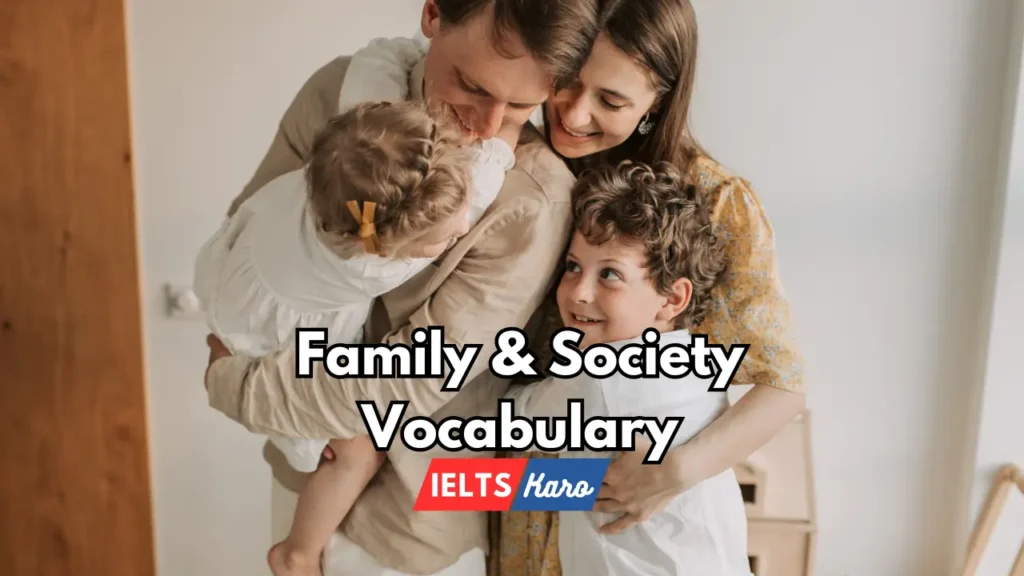
Family, society and social change is one of the most consistently tested topic areas across all three parts of IELTS Speaking and in Writing Task 2. Examiners ask about family structures, parenting, generational differences, gender roles, elderly care, and the changing nature of communities. This page covers all of it.
📌 How to use this guide
Do not try to memorise everything at once. Work through one section per study session. Identify vocabulary that fits your own life, write 2–3 of your own sentences using it, then practise using it in timed speaking responses.
Section 1 – Types of Family
Understanding and correctly using these terms gives you precision when describing family structures in both speaking and writing. The examiner notices when a student uses “nuclear family” instead of just “small family”, it signals vocabulary range.
immediate familynoun phrase
Your closest relatives, typically parents, siblings, and your own children or partner. e.g. My immediate family is small; just my parents and one younger brother.
nuclear familynoun phrase
A family unit of two parents and their children, without extended relatives. e.g. The nuclear family model became dominant in many Western countries during the twentieth century.
extended familynoun phrase
The wider family network including grandparents, aunts, uncles, cousins and in-laws. e.g. In Pakistan, it is still common for three generations to live together as an extended family.
single-parent familynoun phrase
A household where one parent raises children alone, due to divorce, separation, or death of a partner. e.g. The number of single-parent families has risen sharply over the past three decades.
blended familynoun phrase
A family where one or both partners have children from a previous relationship, now living together. e.g. Blended families require patience and open communication to function well.
multigenerational householdnoun phrase
A home in which three or more generations live together, often grandparents, parents and children. e.g. Multigenerational households remain the norm in many parts of South and East Asia.
dysfunctional familynoun phrase
A family unit marked by persistent conflict, neglect, or abusive behaviour that disrupts normal functioning. e.g. Growing up in a dysfunctional family can have long-lasting effects on a child’s emotional development.
close-knit familyadjective phrase
A family whose members have strong bonds, spend time together and support each other actively. e.g. Despite living in different cities, we remain a close-knit family who gather every holiday.
Section 2 – Family Members & Relationships
These are the building blocks of family vocabulary. Go beyond the basics because an examiner will notice when you use “sibling” instead of “brother or sister”, or “spouse” instead of “husband or wife”. The more precise your vocabulary, the higher your Lexical Resource score.
Core Family Terms
siblingnoun
A brother or sister, a gender-neutral and more formal than “brother” or “sister”. e.g. I have two siblings: an older brother and a younger sister.
spousenoun
A husband or wife – formal and gender-neutral. e.g. My spouse and I met at university and married four years later.
partnernoun
A person you are in a committed relationship with, married or not. e.g. She introduced her partner to the family at Christmas dinner.
offspringnoun
A formal or literary term for a person’s children. e.g. Parents often sacrifice enormously for the wellbeing of their offspring.
ancestornoun
A person from whom you are descended, from earlier generations. e.g. I am researching my ancestors to understand where my family originally came from.
descendantnoun
A person who comes after you in the family line – your children, grandchildren, and beyond. e.g. She hoped to leave a better world for her descendants.
next of kinnoun phrase
The person(s) most closely related to you – legally significant in emergencies and medical situations. e.g. In case of emergency, the hospital will contact your next of kin.
blood relativenoun phrase
A person related to you through birth, as opposed to marriage. e.g. My uncle is a blood relative; his wife is related to me only by marriage.
in-lawsnoun (plural)
The family of one’s spouse. e.g. I get along very well with my in-laws – we have dinner with them every Sunday.
guardiannoun
A person legally responsible for a child who is not their biological parent. e.g. After his parents passed away, his uncle became his legal guardian.
Generational Terms
the older generationnoun phrase
People who are significantly older, typically grandparents or elderly relatives. e.g. The older generation in my family place great importance on respect and formality.
the younger generationnoun phrase
People who are significantly younger – children, teenagers, young adults. e.g. The younger generation tend to communicate primarily through social media.
the generation gapnoun phrase
The differences in values, attitudes and experiences between people of different age groups. e.g. The generation gap between my grandparents and my children is striking – they have almost nothing in common technologically.
hereditaryadjective
Passed from parent to child through genetics. e.g. Heart disease is hereditary in my family, so I try to maintain a healthy lifestyle.
Section 3 – Stages of Family Life
IELTS examiners love questions about the life cycle – from relationships and marriage through to parenting and old age. This vocabulary gives you the language to discuss these stages naturally.
Romance & Partnership
courtshipnoun
The period of time when two people are developing a romantic relationship before marriage. e.g. In traditional cultures, courtship was often arranged by families rather than the individuals themselves.
to get engagedverb phrase
To formally agree to marry someone. e.g. They got engaged after three years of dating.
fiancé / fiancéenoun
A man / woman to whom you are engaged to be married. e.g. She introduced her fiancé to her parents for the first time last weekend.
to tie the knotverb phrase (informal)
Informal expression meaning to get married. e.g. They finally tied the knot after being together for eight years.
to settle downverb phrase
To establish a stable home life, typically by marrying and having children. e.g. After years of travelling, he decided it was time to settle down.
Marriage
matrimonynoun (formal)
The formal or literary term for marriage. e.g. They entered into matrimony in a small ceremony attended only by close family.
a civil marriagenoun phrase
A legally recognised marriage performed by a government official rather than a religious leader. e.g. They chose a civil marriage ceremony at the local registry office.
a breadwinnernoun
The member of a household who earns the primary income. e.g. In the past, the father was almost always the breadwinner of the family.
to support the familyverb phrase
To provide financially for one’s family members. e.g. He worked two jobs in order to support the family after losing his main income.
Children & Parenting
upbringingnoun
The way in which a child is raised, the values, discipline and experiences provided by parents. e.g. Her confident personality is a direct result of her positive upbringing.
to raise / bring up a childverb phrase
To care for and educate a child as they grow. e.g. It takes enormous effort and love to raise a child well in today’s demanding world.
parental responsibilitynoun phrase
The legal and moral duty of parents to care for and make decisions for their children. e.g. Parental responsibility includes both financial support and emotional guidance.
childcarenoun
The supervision and care of children, especially while parents are working. e.g. Affordable childcare remains one of the biggest challenges facing working families.
to discipline a childverb phrase
To set and enforce boundaries of acceptable behaviour for a child. e.g. Experts suggest that the most effective way to discipline a child is through clear and consistent rules.
overprotectiveadjective
Excessively shielding a child from risk or challenge, to the point where it limits their development. e.g. Overprotective parenting can prevent children from developing the resilience they need in later life.
formative yearsnoun phrase
The early period of a person’s life when character and values are shaped. e.g. The experiences of a person’s formative years have a lasting impact on who they become.
Later Life & Elder Care
to grow old gracefullyverb phrase
To age without resisting or mourning the process, accepting the natural changes of ageing. e.g. She has grown old gracefully, remaining active and engaged with life well into her eighties.
elderly dependantnoun phrase
An older person who relies on others for care and support. e.g. Many families struggle financially when they have an elderly dependant living with them.
a care home / nursing homenoun phrase
A residential facility providing personal care and medical support for elderly people. e.g. After his health deteriorated, the family decided a care home was the safest option.
filial dutynoun phrase
The responsibility of children to care for and respect their parents. e.g. In many Asian cultures, filial duty is considered one of the most important moral obligations.
Section 4 – Family Relationships & Dynamics
These words describe how families function; the quality of their relationships, sources of tension and patterns of interaction. This vocabulary is particularly useful for Part 3 discussions.
family bondnoun phrase
The emotional connection between family members. e.g. Strong family bonds provide a sense of security and belonging throughout life.
family tiesnoun phrase (plural)
The connections and obligations linking family members together. e.g. Even after moving abroad, she maintained strong family ties through regular video calls.
to get along / get on withverb phrase
To have a positive, harmonious relationship with someone. e.g. I get along very well with my siblings now, even though we argued constantly as children.
sibling rivalrynoun phrase
Competition and jealousy between brothers and sisters. e.g. Sibling rivalry is perfectly normal in childhood, but it usually fades as people mature.
family gatheringnoun phrase
An occasion when family members come together, typically for a celebration or event. e.g. Our annual family gathering at Eid is one of the highlights of the year.
estrangementnoun
The state of being emotionally distant or having cut off contact with a family member. e.g. Family estrangement is becoming more common, particularly between adult children and parents.
reconciliationnoun
The restoration of a friendly relationship after a period of conflict or estrangement. e.g. After years of not speaking, the two brothers achieved a reconciliation before their father passed away.
domestic responsibilitiesnoun phrase
The tasks and duties involved in managing a household; cooking, cleaning, childcare. e.g. The unequal distribution of domestic responsibilities remains a source of tension in many marriages.
Section 5 – Society, Social Change & Modern Family Trends
This is the vocabulary you need for Part 3 discussions and Writing Task 2 essays. These terms allow you to discuss family not just as a personal topic but as a social and political one, which is exactly what Band 7+ responses require.
social cohesionnoun phrase
The degree to which members of a society feel connected, share common values and trust one another. e.g. Strong family structures are often cited as a foundation of social cohesion.
demographic shiftnoun phrase
A significant change in the composition of a population, age, birth rate, household size. e.g. A major demographic shift in many countries is the rapid growth of the elderly population.
birth rate / fertility ratenoun phrase
The number of births per thousand of population / per woman of childbearing age. e.g. Declining birth rates in developed nations have created pressure on pension and healthcare systems.
ageing populationnoun phrase
A population in which the proportion of older people is growing relative to younger age groups. e.g. An ageing population creates both economic challenges and opportunities for healthcare providers.
social mobilitynoun phrase
The ability of individuals or families to move between economic and social classes. e.g. Access to quality education is one of the most powerful drivers of social mobility.
gender rolesnoun phrase (plural)
Socially constructed expectations about the behaviour and responsibilities appropriate to men and women. e.g. Traditional gender roles within families have shifted considerably over the past fifty years.
work-life balancenoun phrase
The degree to which a person can manage the demands of their job alongside their personal and family life. e.g. Poor work-life balance is a leading cause of family breakdown in high-pressure economies.
family breakdownnoun phrase
The disintegration of a family unit, typically through divorce or separation. e.g. Rising rates of family breakdown have prompted governments to invest more in relationship counselling.
divorce ratenoun phrase
The number or proportion of marriages that end in divorce. e.g. Countries with high divorce rates often also show lower rates of child wellbeing.
community supportnoun phrase
The assistance provided by neighbours, local organisations or society at large to families in need. e.g. Community support played a vital role in helping families during the pandemic.
Section 6 – Essential Collocations
Collocations are word combinations that native speakers use naturally. Using them correctly demonstrates a sophisticated command of English, one of the key markers of Band 7 Lexical Resource. Incorrect collocations are one of the most common reasons for losing marks.
Verb + Family Collocations
Verb
+ Family word
Full collocation
raise
children
raise children with strong values
provide for
a family
struggle to provide for a family on one salary
maintain
family ties
maintain family ties despite living abroad
strengthen
family bonds
activities that strengthen family bonds
break up
a family
financial stress can break up a family
start
a family
many couples delay starting a family until their thirties
support
elderly parents
the duty to support elderly parents financially
uphold
family traditions
younger generations often uphold family traditions
Adjective + Family/Society Collocations
Adjective
Noun
Common phrase
close-knit
family
a close-knit family that supports each other
dysfunctional
family unit
children from a dysfunctional family unit
multigenerational
household
a multigenerational household under one roof
declining
birth rate
a declining birth rate in urban areas
ageing
population
the challenges of an ageing population
increasing
divorce rate
an increasing divorce rate among young couples
shared
domestic responsibilities
shared domestic responsibilities within a marriage
strong
family values
a culture built on strong family values
Section 7 – Idioms & Expressions
Idioms used naturally and accurately in the Speaking test demonstrate genuine language fluency. Use them only when they fit naturally. One or two well-placed idioms per response is more than enough.
Idiom / Phrase
Meaning + Example
blood is thicker than water
Family loyalty is more important than other relationships. e.g. When I needed help, my friends were nowhere to be found, but my brother drove four hours. Blood is thicker than water.
the apple doesn’t fall far from the tree
Children usually turn out similar to their parents in character or ability. e.g. She became a doctor, just like her father. The apple doesn’t fall far from the tree.
it runs in the family
A particular trait, talent or condition is shared by many family members. e.g. Musical ability runs in our family including my grandfather, father and I all play the piano.
like father, like son
A son behaves or has the same characteristics as his father. e.g. He’s become just as stubborn as his dad. Like father, like son.
to follow in someone’s footsteps
To pursue the same career or life path as a parent or mentor. e.g. She followed in her mother’s footsteps and became a teacher.
the black sheep of the family
The family member who is considered the embarrassment or who does not conform to family norms. e.g. My uncle was always the black sheep, he refused to join the family business and became an artist.
to have a soft spot for someone
To feel a particular affection for one person. e.g. My grandfather always had a soft spot for me, I was the youngest grandchild.
to be at loggerheads
To be in strong disagreement with someone. e.g. My parents were constantly at loggerheads over money when I was young.
to keep in touch with
To maintain regular contact with someone. e.g. Even after moving abroad, she made sure to keep in touch with her extended family.
a chip off the old block
Identical in character to one’s parent. e.g. He’s so like his father, a real chip off the old block.
Section 8 – Speaking Practice: Parts 1, 2 & 3
The following questions and sample answers show you how to use this vocabulary naturally under exam conditions. Pay attention to the words highlighted in each answer, these are drawn directly from the vocabulary sections above.
Part 1 – Personal Questions
In Part 1, questions about family are almost always among the first asked. Keep answers concise (3–5 sentences), personal and natural. Avoid reciting lists.
Examiner: How many people are there in your immediate family?
There are five of us in my immediate family; my parents, two siblings, and me. We are a fairly close-knit family, even though my older brother now lives in another city for work. We try to get together for family gatherings on major occasions, particularly during Eid, when the whole extended family comes together.
Examiner: Who are you closest to in your family?
I would have to say my mother. She has always had a soft spot for me; I am the youngest child and she played the biggest role in my upbringing. We speak on the phone almost every day, and she has always been the first person I turn to for advice. I think the bond between a mother and child is particularly strong in our culture.
Examiner: Has the structure of families in your country changed much in recent years?
Quite significantly, yes. The extended family household, where three generations lived under one roof, used to be the norm here. But over the past two decades, as more people have moved to cities for work, the nuclear family has become more common. There is also a noticeable generational shift in attitudes, younger couples are starting families later and having fewer children. I think work-life balance pressures play a large role in that change.
Part 2 — Cue Card: Describe a Family Member You Admire
This is one of the most common cue cards on the topic of family. A strong Band 7+ answer should include specific details, vocabulary from Section 2 and 3, and at least one idiom used naturally.
Cue Card
Describe a family member you admire. You should say: who this person is, what they are like, and how they have influenced your life. And explain why you admire them.
Examiner: Part 2 — Band 7+ Sample Response
The family member I admire most is my maternal grandfather, who passed away three years ago at the age of eighty-four. He was the classic breadwinner of his generation; he worked as a schoolteacher for over forty years and single-handedly supported a family of six children on what was a very modest income. He never complained. He was the kind of man who believed that providing for his family was simply his duty, not a burden. What I admire most, though, was his character. He was patient in a way I have never seen in anyone else. Despite raising six children in difficult economic circumstances, he never raised his voice. His upbringing had been even harder as he came from a very poor household himself and yet managed to give all his children an education and a stable, loving home. He had a profound influence on my own values. I grew up watching a man who followed in his own father’s footsteps as a teacher and it shaped how I think about responsibility, patience and service. People used to say the apple doesn’t fall far from the tree when talking about my mother, because she shares his quiet, determined character. I like to think I have inherited a little of that too. He is the reason I believe that the most important things a family can pass on to the next generation are values, not wealth.
Part 3 — Abstract Discussion Questions
In Part 3, questions about family become social and philosophical. Use the SPEAK method and draw on vocabulary from Sections 4 and 5 to show depth of thought.
Examiner: How have family structures changed in your country over the past few decades?
The change has been substantial and largely driven by urbanisation and economic pressure. A generation ago, multigenerational households were the norm in Pakistan; grandparents, parents and children all living under one roof. That arrangement served both practical and emotional purposes: grandparents provided childcare while younger adults worked, and elderly relatives were cared for within the family rather than being placed in nursing homes. As people have moved to cities for better opportunities, that model has fractured. Nuclear families are now far more common in urban areas. And with both parents often working full-time to manage the rising cost of living, even the nuclear family unit is under pressure. The divorce rate, while still much lower than in many Western countries, has risen noticeably. And the birth rate has declined, particularly among educated urban women who are prioritising careers. I think we are at an interesting crossroads. The economic pressures pushing families apart are real, but there is also a growing awareness of the mental health costs of isolation, which may eventually push back towards more communal ways of living.
Examiner: Who should be responsible for caring for elderly people — families or the government?
My view is that both must share responsibility, treating it as an either/or question leads to poor policy and abandoned families. Families often provide what institutional care cannot replicate: emotional warmth, personal attention and the dignity of being cared for by people who love you. In many cultures, placing a parent in a care home carries a strong social stigma, and for good reason it can feel like an abandonment of filial duty. But it is unrealistic and unfair to place the entire burden on families. Not every household has the physical space, financial resources or emotional capacity to provide full-time elder care. A daughter who is also raising children and working full-time simply cannot do everything. Governments in countries with ageing populations, which is most of the developed world now must fund quality care systems, provide financial support for family carers, and create respite services that allow families to share the load with the state. The societies that handle this best are those that see elder care as collective infrastructure, not a private family problem.
Examiner: Do you think the generation gap between parents and children is wider today than in the past?
In many ways, yes, though the nature of the gap has changed rather than simply grown. The speed of technological change is the most obvious driver. My grandparents and parents shared broadly similar life experiences. Today, a teenager’s entire social life may exist on platforms their parents have never used, in a digital environment their parents find genuinely alien. Beyond technology, values have diverged more rapidly. Younger generations tend to hold significantly different views on gender roles, career expectations, marriage and lifestyle than the older generation and this creates real friction within families. That said, I do not think this means family bonds have weakened. In fact, there is research suggesting that many young adults today feel closer to their parents than previous generations did. The generation gap in values does not necessarily mean estrangement. Perhaps the gap is wider in terms of cultural reference points and daily experience, but narrower in terms of emotional connection.
Section 9 – Writing Task 2: Using Family & Society Vocabulary
The vocabulary in this guide is equally valuable in Writing Task 2 essays. Below are examples of how to deploy key terms in essay language.
Useful Sentence Starters for Essay Writing
Discussing change
The structure of the family unit has undergone a significant transformation over the past few decades, with the nuclear family gradually replacing the multigenerational household in many urban areas.
Presenting a social issue
The declining birth rate in many developed countries poses serious long-term challenges for both pension systems and the workforce.
Arguing a position
While the primary responsibility for childcare should rest with the family, governments have a clear duty to provide affordable, high-quality childcare infrastructure for working parents.
Acknowledging complexity
Although traditional family values continue to play an important role in many societies, it would be an oversimplification to suggest that changing family structures are inherently negative.
Concluding
Ultimately, the health of any society depends in large part on the strength of its family bonds and the quality of care it provides for both its youngest and oldest members.
Section 10 – Quick Reference: 50 Words & Phrases to Know
This reference list gives you the most important vocabulary from this guide in one place. Use it for final review before your exam.
Family Types & Structure
Relationships & Dynamics
Society & Social Change
immediate family
sibling rivalry
demographic shift
nuclear family
family bond
declining birth rate
extended family
family ties
ageing population
blended family
generation gap
social cohesion
multigenerational household
estrangement
gender roles
single-parent family
reconciliation
social mobility
close-knit family
filial duty
work-life balance
dysfunctional family
domestic responsibilities
family breakdown
breadwinner
upbringing
divorce rate
next of kin
parental responsibility
community support
Q: What is the most important family vocabulary for IELTS?
The most important family vocabulary for IELTS includes terms for family types (nuclear family, extended family, multigenerational household), relationship words (sibling, spouse, offspring, next of kin), life stage vocabulary (upbringing, filial duty, breadwinner), and social terms (generation gap, social cohesion, demographic shift).
Q: How do I talk about family in IELTS Speaking Part 1?
In IELTS Speaking Part 1, answer family questions with 3 to 5 natural sentences. Describe your immediate or extended family, mention how close-knit you are, and use specific vocabulary like ‘sibling’, ‘close-knit family’, or ‘family gathering’. Avoid one-word answers.
Q: What family idioms can I use in IELTS Speaking?
Useful family idioms for IELTS Speaking include: ‘blood is thicker than water’ (family loyalty is stronger than other relationships), ‘it runs in the family’ (a trait shared by many family members), ‘the apple doesn’t fall far from the tree’ (children resemble their parents), ‘like father, like son’ (a son behaves like his father), and ‘the black sheep of the family’ (a family member who does not conform to family norms). Use one or two idioms per response — only when they fit naturally.
Q: Is family a common topic in IELTS?
Yes, family is one of the most frequently tested topics across all four IELTS modules. In Speaking, it appears in Part 1 (personal questions about your family), Part 2 (cue cards about a family member or family event), and Part 3 (abstract questions about family structures and social change). In Writing Task 2, essays regularly cover childcare, elderly care, gender roles in families, and declining birth rates. Building a strong family vocabulary is one of the highest-return investments in IELTS preparation.
Q: How do I write about family in IELTS Writing Task 2?
In IELTS Writing Task 2, family topics often appear as essays about childcare, elderly care, working parents, divorce rates or changing social structures. Use formal vocabulary such as ‘the declining birth rate’, ‘the ageing population’, ‘parental responsibility’, ‘work-life balance’, and ‘social cohesion’. Avoid informal words.
Which vocabulary from this list do you find most difficult to use naturally? Drop it in the comments and I will show you how to use it in a sentence that fits your own life!
ieltskaro.com | IELTS Family & Society Vocabulary | Updated March 2026
Practise This Vocabulary in Real IELTS Conditions IELTSKaro’s AI Speaking Simulator gives you real Part 1, 2 and 3 questions. Use your new vocabulary under the pressure of the actual test format, no booking required. Try It Now at IELTSKaro.com
I am Yasir, an IELTS trainer and digital educator with over a decade of experience in content, communication coaching, and EdTech. My IELTS band score is 8.5 and I am genuinely interested in helping you to get your desired band score. I am also the founder of IELTSKaro, backed by Google for Startups and ElevenLabs.
IELTS Made Easy
Achieve Your Target Score
Unlock Your Global Potential with Our Extensive Online IELTS Preparation BootCamp