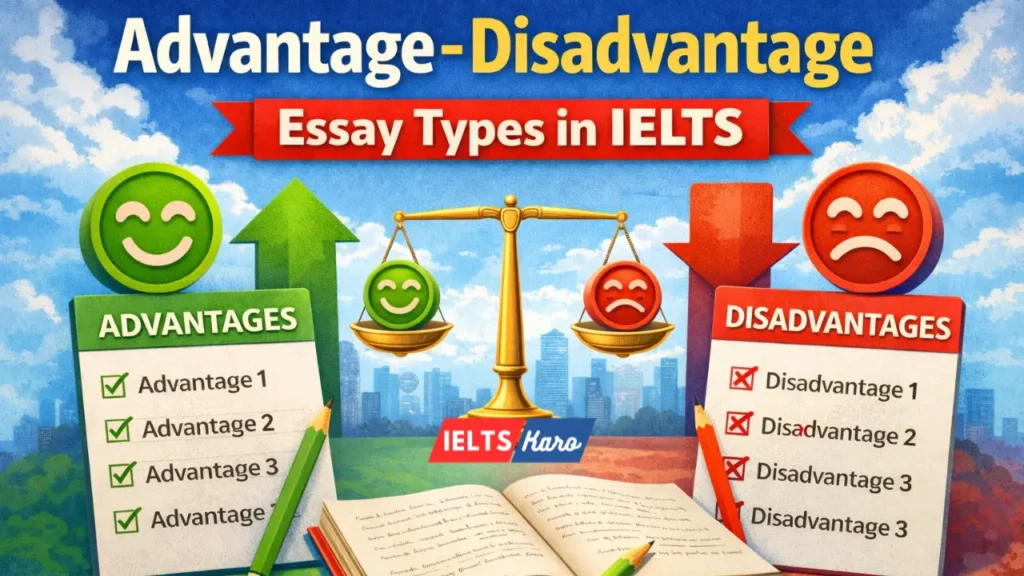
The Advantage/Disadvantage essay is one of the most common questions in IELTS Writing Task 2. However, it is also the essay type where candidates lose the most points for Task Response. In this guide, I will share 3 Advantages/Disadvantages essay types, critically analyze them with teacher remarks and teach you how to write one.
Students treat all IELTS Advantage Disadvantage essay questions exactly the same. In reality, the IELTS examiner can ask you this question in two very different ways, and if you use the wrong structure, your score will automatically drop to a Band 5.0. In this comprehensive guide, we will break down the two different types of questions, the famous “outweigh trap,” the exact sentence-by-sentence structure you need, and high-level vocabulary to boost your score.
The Trap: Two Different Question Types
Before you write a single word, you must look at the prompt and determine which of the two question types you are answering.
Type 1: The “Discussion” (No Opinion Required)
Prompt Example: In many countries, young people take a gap year before starting university. What are the advantages and disadvantages of this?
The Rule: This question does not ask for your opinion. You are acting as a neutral reporter. You simply need to state the benefits in one paragraph, the drawbacks in another, and conclude. If you say “I believe this is a good thing” in your essay, you will lose points because you answered a question that wasn’t asked.
Type 2: The “Outweigh” (Opinion Required)
Prompt Example: Some experts believe that children should begin learning a foreign language at primary school rather than secondary school. Do the advantages of this outweigh the disadvantages?
The Rule: This question demands your opinion. You must clearly state whether the positive aspects are stronger than the negative aspects. Your opinion must be clear from the very first paragraph (your introduction) to the last.
The “Outweigh” Secret: Weight vs. Numbers
When students see the word “outweigh,” they usually make a fatal mathematical mistake. They think they need to write three advantages and only one disadvantage to prove that the advantages are stronger.
This is wrong. In IELTS, “outweigh” does not mean “more in number.” It means “stronger in importance.”
Think of it like buying a Ferrari.
- Advantages: It is incredibly fast, and it looks beautiful (2 advantages).
- Disadvantage: It costs $400,000 (1 disadvantage).
Even though there are more advantages, the single disadvantage (the massive cost) is so heavy that it outweighs the benefits for 99% of people. Therefore, you only ever need to write one or two well-explained ideas per paragraph. Do not write a shopping list of ideas. Quality always beats quantity.
The Sentence-by-Sentence Essay Blueprints
To score highly in Coherence and Cohesion, you should use a predictable, logical structure. Here is the blueprint for both types.
Blueprint for Type 1 (What are the adv/disadv?)
Paragraph 1: Introduction
- Sentence 1: Paraphrase the question statement.
- Sentence 2: Outline statement (Tell the examiner exactly what the essay will discuss).
Paragraph 2: Advantages
- Sentence 3: Topic Sentence (State the main advantage clearly).
- Sentence 4: Explanation (Explain why or how this is an advantage).
- Sentence 5: Result/Addition (Give a secondary benefit or result of the first one).
- Sentence 6: Example (Provide a real-world example to support your claim).
Paragraph 3: Disadvantages
- Sentence 7: Topic Sentence (State the main disadvantage).
- Sentence 8: Explanation (Explain why this is a problem).
- Sentence 9: Result (What happens because of this problem?).
- Sentence 10: Example (Provide a relevant example).
Paragraph 4: Conclusion
- Sentence 11: Summary (Summarize the main advantage and disadvantage without giving an opinion).
Blueprint for Type 2 (Do the adv outweigh the disadv?)
Paragraph 1: Introduction
- Sentence 1: Paraphrase the question.
- Sentence 2: Thesis Statement (State clearly which side outweighs the other).
Paragraph 2: The Weaker Side (Concession Paragraph)
- Sentence 3: Topic Sentence (Acknowledge the opposing side).
- Sentence 4: Explain the point.
- Sentence 5: Example.
Paragraph 3: The Stronger Side (Your Opinion Paragraph)
- Sentence 6: Topic Sentence (State your main argument).
- Sentence 7: Explain why this point is so significant.
- Sentence 8: Further extension or second supporting point.
- Sentence 9: Example.
Paragraph 4: Conclusion
- Sentence 10: Summary and Final Restatement (Summarize why the stronger side defeats the weaker side).
High-Scoring Vocabulary for This Essay Type
To avoid repeating the words “advantage” and “disadvantage” ten times in your essay, memorize these Band 7+ synonyms:
For Advantages:
- A significant benefit of this development is…
- One primary positive aspect is…
- This trend is highly advantageous because…
- A major upside to this is…
For Disadvantages:
- A notable drawback is…
- One of the primary downsides is…
- A negative consequence of this trend is…
- This can be highly detrimental because…
For Weighing Options:
- Despite the aforementioned drawbacks, the benefits are vastly more significant…
- While there are valid concerns, the positive outcomes easily overshadow the negatives.
Model Essay 1: The “No Opinion” Blueprint (Type 1)
Prompt: The development of tourism contributed to English becoming the most prominent language in the world. Some people think that this will lead to English being the only language spoken in the world. What are the advantages and disadvantages to having one universal language in the world?
Teacher’s Note: Notice how the prompt only asks “what are the advantages and disadvantages?” It does not ask if this is a good or bad thing. The essay below acts as a neutral reporter, presenting both sides without bias.
Tourism has always had a significant economic impact on countries globally. Some believe that this phenomenon has made English the most spoken language, potentially leading to it becoming the sole predominant language in the future. While there are distinct economic and communicative benefits to having a universal language, it does not come without severe cultural drawbacks.
One clear benefit of having English as a universal language is that the entire world could communicate with each other effortlessly. In simple terms, if everyone started writing and speaking in one uniform language, it would immediately remove any barriers to global communication. Another distinct advantage is that economies could significantly increase trade and improve diplomatic relationships, resulting in enhanced prosperity and economic growth for developing nations.
On the flip side, these communicative benefits come at a great cost to heritage. A universal language would inevitably mean the eventual disappearance of all other indigenous languages throughout the world. For instance, if everyone in my country exclusively spoke English, local cultural nuances and historical storytelling would become meaningless, leading to a loss of national identity. Another demerit is that English itself may lose its dynamic flavor and richness, which historically comes from absorbing words from other local dialects.
To conclude, while a universal language would undeniably boost global trade and ease communication, it would simultaneously threaten global diversity by causing the extinction of local languages.
Why this scores a Band 8+:
- Perfect Alignment: It follows the Type 1 Blueprint flawlessly: Intro, Advantages, Disadvantages, Neutral Conclusion.
- Lexical Resource: Uses high-level, precise phrasing (sole predominant language, indigenous languages, cultural nuances, dynamic flavor).
- Task Response: The conclusion is perfectly neutral, merely summarizing the two body paragraphs without forcefully giving an opinion.
Model Essay 2: The “Outweigh” Blueprint (Type 2)
Prompt: Globally, there is a strong trend among people preferring to buy ready-to-eat meals rather than spending time cooking in the kitchen. Do the advantages of this trend outweigh the disadvantages?
Teacher’s Note: This prompt requires a clear opinion. Watch how the writer groups the “weaker” side into one paragraph, and then uses the “stronger” side paragraph to dominate the argument.
Globally, there is a growing trend of individuals relying on pre-packaged, ready-to-eat meals instead of preparing food at home. While there are undeniable conveniences associated with buying processed foods, I believe the financial and health drawbacks of this habit significantly outweigh any time-saving benefits.
On the one hand, there are distinct advantages to purchasing pre-made meals, primarily regarding convenience. Many working professionals simply do not have the time to buy raw ingredients and spend hours in the kitchen after a long commute. Ready-to-eat meals provide an immediate option that slashes the time required to feed a family. For instance, in urban areas of Canada, many university students heavily rely on these quick options to maintain their rigorous study schedules without the added stress of cooking.
However, the disadvantages of this trend are far more impactful, especially concerning long-term health and personal finances. First and foremost, eating ready-to-eat food is usually highly processed and rich in saturated fats, artificial flavors, and chemical preservatives. While this makes the food highly palatable, it is nutritionally hollow and leads directly to chronic issues such as obesity and heart disease. Furthermore, the financial burden is substantial; restaurants and supermarkets factor high profit margins into convenience foods. The cost of eating a single processed meal out could easily fund fresh, nutritious, home-cooked ingredients for an entire day, making it an economically unsustainable habit for the average person.
To conclude, although ready-to-eat meals offer a quick fix for those with busy schedules, the severe health risks and exorbitant financial costs make it a highly detrimental trend overall.
Why this scores a Band 8+
- Clear Thesis: The introduction leaves no doubt about the writer’s position (“I believe the financial and health drawbacks… significantly outweigh”).
- The Concession Paragraph: It politely acknowledges why people buy fast food (time savings) before destroying that argument in the next paragraph.
- Complex Grouping: It successfully groups two distinct disadvantages (health risks + financial costs) into one powerful, cohesive paragraph without sounding like a robotic list.
Model Essay 3: The Complex Double-Prompt (Advanced Grouping)
Prompt: Many people claim that the threat of possessing nuclear weapons maintains world peace. Furthermore, many believe nuclear power is a clean and economical energy source. Do the disadvantages of nuclear technology outweigh its advantages?
Teacher’s Note: When faced with a massive topic like “nuclear energy AND weapons,” many students write four short, choppy paragraphs. To hit a high Band score, you must combine your ideas into two deep, well-developed paragraphs.
The development of nuclear technology has profoundly shaped modern geopolitics and energy production. While proponents argue that nuclear capabilities ensure global deterrence and provide affordable electricity, I firmly believe the existential threats of arms races and catastrophic accidents heavily outweigh these purported benefits.
Admittedly, there are strategic and economic advantages to nuclear development. From a military standpoint, a nuclear-armed country presents a formidable threat to any aggressor, effectively acting as a deterrent to maintain regional peace. For instance, nations like mine rely on their nuclear arsenals to secure their borders against larger neighbors. Additionally, from an infrastructural perspective, nuclear energy is championed as an affordable, zero-emission alternative to fossil fuels. Many Asian economies are increasingly transitioning to nuclear power to meet massive grid demands without producing greenhouse gases.
Conversely, the drawbacks of nuclear technology present an unparalleled danger to human survival. Developing nuclear weapons inherently triggers a reactionary arms race. Major economies like the US, Russia, and China have accumulated deadly stockpiles that, rather than ensuring peace, constantly threaten global annihilation due to political instability or miscalculation. Furthermore, the civilian use of nuclear energy is fraught with logistical and safety nightmares. Enriching uranium requires enormous capital and highly skilled labor, which most developing nations lack. More critically, the risk of reactor meltdowns or the mishandling of radioactive waste poses environmental hazards that can render regions uninhabitable for centuries.
In conclusion, despite the benefits of military deterrence and low-carbon electricity, the constant threat of a global arms race and the severe risks of radioactive contamination mean that nuclear technology’s disadvantages vastly overshadow its advantages.
Related Posts
Why this scores a Band 8+:
- Masterful Grouping: The writer took a highly complex prompt and beautifully condensed it into the standard blueprint. Paragraph 2 handles both advantages (deterrence + energy). Paragraph 3 handles both disadvantages (arms race + meltdowns).
- Elite Vocabulary: Existential threats, formidable threat, civilian use, fraught with logistical nightmares, render regions uninhabitable. * Cohesion: Notice how the transition word “Conversely” perfectly signals the shift from the weaker side to the stronger, more dangerous side.
FAQs:
Do I need to give my personal opinion in an advantage/disadvantage essay?
It depends entirely on the exact wording of the question. If the question simply asks, “What are the advantages and disadvantages?”, you must remain completely neutral and act as a reporter. If you give your opinion, you will lose points. However, if the prompt asks, “Do the advantages outweigh the disadvantages?”, you must provide your opinion clearly throughout the entire essay, starting from the introduction.
How many advantages and disadvantages should I write?
The biggest mistake students make is treating the essay like a shopping list and trying to write 3 or 4 advantages. In IELTS, depth is more important than quantity. You should aim for one or two well-developed ideas per body paragraph. Explain your main point fully and provide a clear example. Focus no more than 2 advantages and 2 disadvantages.
If the question asks if advantages “outweigh” disadvantages, do I need to write more advantages than disadvantages?
No. In IELTS, “outweigh” refers to the importance or weight of an idea, not the mathematical number of ideas. You can have two minor advantages and only one massive disadvantage, and argue that the single disadvantage outweighs the benefits. Focus on the strength of your argument, not the number of points.
Can I use bullet points to list the advantages and disadvantages?
Absolutely not. IELTS Writing Task 2 is a formal academic essay. If you use bullet points, numbering (1, 2, 3), or subheadings anywhere in your essay, you will be heavily penalized by the examiner. You must use standard paragraph formatting and transition words (e.g., Firstly, Furthermore, Consequently) to connect your ideas.
What if I can only think of one advantage during the exam?
Don’t panic! It is perfectly acceptable to write a body paragraph focused entirely on one single advantage. Instead of stressing about finding a second point, use your word count to deeply extend that one idea. State the advantage, explain why it is an advantage, explain the result of this advantage, and provide a highly specific real-world example. A single, perfectly explained point will always score higher than three poorly explained ones.