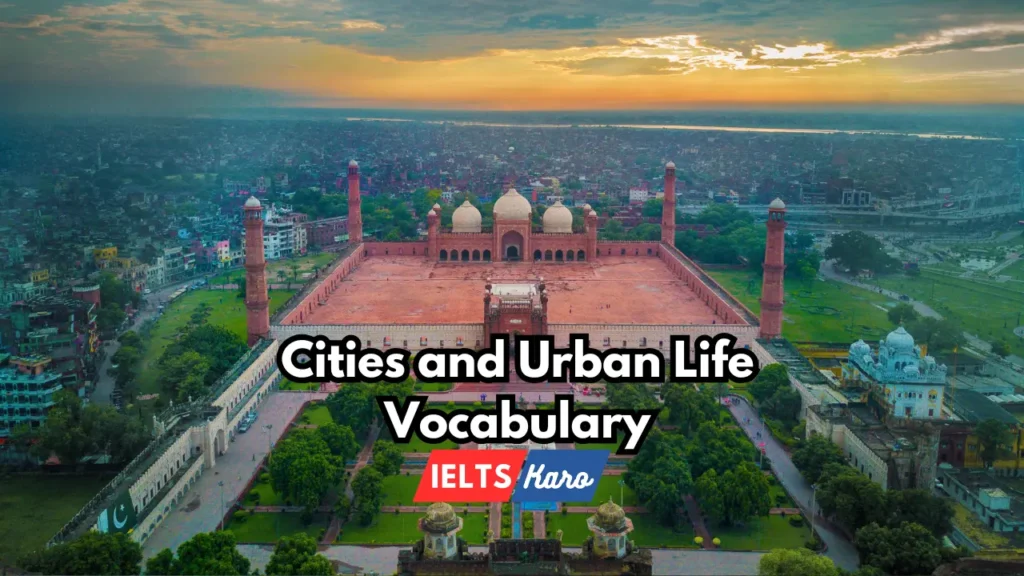
Why Cities & Urban Life Is a High-Priority IELTS Topic
Cities and urban life is one of the broadest and most frequently tested IELTS topics. It appears across all three parts of the Speaking test such as hometown questions in Part 1, cue cards about cities and places in Part 2, and abstract discussions about urbanisation, housing and transport in Part 3. In Writing Task 2, essays on traffic congestion, affordable housing, urban planning, public transport and smart cities appear every year without exception.
The reason this topic is so rich is that it connects to almost everything else. A question about cities can quickly become a question about the environment (urban carbon emissions), society (gentrification and inequality), technology (smart cities and surveillance), health (urban green spaces and mental health), or government (urban planning policy). Students who know this vocabulary well can handle all of these overlaps fluently.
This guide covers 100 words and phrases across six thematic sections, with natural collocations, idioms for speaking, full Band 7+ sample answers for all three speaking parts, Writing Task 2 sentence starters, and FAQ schema for the page.
📌 How to use this guide
Study one section per session. For each new term, write one sentence about your own city or hometown using it. Then practise using it in a timed speaking response before moving to the next section.
Section 1 – Urbanisation & Population
Urbanisation is the foundational concept for this topic. These terms allow you to discuss why cities grow, what drives people to move to them, and what consequences follow from rapid or unplanned growth. They are essential for both Part 3 discussions and Writing Task 2 essays.
urbanisationnoun
The process by which an increasing proportion of a population comes to live and work in towns and cities rather than rural areas. e.g. Rapid urbanisation across South and Southeast Asia has transformed economies while placing enormous strain on infrastructure.
rural-urban migrationnoun phrase
The movement of people from the countryside to cities, typically in search of better employment, education or public services. e.g. Rural-urban migration is the primary driver of population growth in cities across the developing world.
urban sprawlnoun phrase
The uncontrolled expansion of urban areas into surrounding rural or agricultural land. e.g. Unchecked urban sprawl consumes farmland, increases car dependency and makes the delivery of public services far more expensive.
overpopulationnoun
A condition in which a region or city has more people than its infrastructure, resources and environment can sustainably support. e.g. Overpopulation in megacities leads to pressure on water supplies, sanitation and public health systems.
population densitynoun phrase
The number of people living per unit of area, typically per square kilometre. e.g. High population density in urban centres creates both economic opportunity and significant social and environmental challenges.
megacitynoun
A city with a population exceeding ten million people. e.g. Megacities like Karachi, Mumbai and Lagos face governance and infrastructure challenges that smaller cities simply do not encounter at the same scale.
satellite townnoun phrase
A smaller town built near a large city to reduce pressure on it, often designed to be semi-independent. e.g. Several satellite towns have been developed around Lahore to absorb population growth from the metropolitan area.
decentralisationnoun
The transfer of power, people or activity from a central city to smaller cities or regions. e.g. Decentralisation of government services and economic activity can reduce pressure on capital cities and stimulate regional growth.
demographic pressurenoun phrase
The strain placed on infrastructure, housing and services by a growing or rapidly changing population. e.g. Demographic pressure from a young and rapidly urbanising population is one of the defining policy challenges in Pakistan.
migration patternnoun phrase
The observable trend in how and where people move within or between countries or regions. e.g. Changing migration patterns show that secondary cities are now attracting more internal migrants than they did a decade ago.
Section 2 – Housing & Affordability
Housing is one of the most politically charged aspects of urban life and one of the most commonly tested sub-topics in IELTS Writing Task 2. These terms allow you to discuss housing access, affordability, planning and the social consequences of housing inequality with precision.
affordable housingnoun phrase
Residential accommodation priced within the financial reach of people on low and middle incomes. e.g. The shortage of affordable housing in major cities has become one of the defining political crises of the decade.
social housingnoun phrase
Housing provided by the government or non-profit organisations at below-market rents for people who cannot afford private accommodation. e.g. Social housing provides a critical safety net for low-income residents but is chronically underfunded in most countries.
gentrificationnoun
The process by which wealthier residents and businesses move into a previously low-income neighbourhood, improving its physical appearance while displacing existing lower-income communities. e.g. Gentrification has transformed several historically working-class districts of Karachi, raising property values while pricing out long-term residents.
housing affordability crisisnoun phrase
A situation in which a large proportion of the population cannot afford adequate housing in the city where they work. e.g. The housing affordability crisis is most acute in cities where property prices have risen far faster than wages.
overcrowdingnoun
A condition in which more people are living in a space than it can comfortably and safely accommodate. e.g. Overcrowding in low-income urban neighbourhoods increases the risk of disease transmission and contributes to social stress.
high-rise developmentnoun phrase
The construction of tall residential or commercial buildings, typically as a response to land scarcity in urban areas. e.g. High-rise development has transformed the skyline of many Asian cities over the past two decades.
slum / informal settlementnoun phrase
A densely populated area of substandard housing, typically without reliable access to clean water, sanitation or legal tenure. e.g. Over one billion people worldwide live in informal settlements that lack basic infrastructure and legal recognition.
property speculationnoun phrase
The purchase of real estate primarily for investment gain rather than to live in, often contributing to price inflation. e.g. Property speculation by wealthy investors has been identified as a key driver of the housing affordability crisis in cities like London and Sydney.
mixed-use developmentnoun phrase
Urban development that combines residential, commercial and recreational spaces in the same area or building. e.g. Mixed-use development reduces the need for long commutes and creates more vibrant, self-sufficient neighbourhoods.
urban regenerationnoun phrase
The renewal and improvement of deteriorated or deprived urban areas through investment and redevelopment. e.g. Urban regeneration projects in former industrial districts have transformed them into cultural and commercial hubs.
Section 3 – Transport & Infrastructure
Transport is consistently among the most tested sub-topics within the cities theme. These terms cover public transport systems, private vehicle issues, sustainable alternatives and the infrastructure that connects urban areas. They are equally useful in Speaking Part 3 and Writing Task 2.
public transportnoun phrase
Transport services available to the general public, including buses, trains, metro systems and trams. e.g. Cities with reliable, affordable public transport consistently report lower carbon emissions, less congestion and better quality of life for residents.
traffic congestionnoun phrase
The condition in which a road network is carrying more traffic than it can handle efficiently, resulting in slow movement and delays. e.g. Traffic congestion costs urban economies billions annually in lost productivity and increased fuel consumption.
commuternoun
A person who travels regularly between their home and their place of work, typically over a significant distance. e.g. The average commuter in a major city spends over an hour each day travelling to and from work.
pedestrianisationnoun
The conversion of a road or area to use by pedestrians only, excluding motor vehicles. e.g. Pedestrianisation of city centres has been shown to increase retail activity, reduce pollution and improve the wellbeing of residents.
cycling infrastructurenoun phrase
The physical network of cycle lanes, parking facilities and road design features that support cycling as a mode of transport. e.g. Cities that have invested seriously in cycling infrastructure report significant reductions in both congestion and carbon emissions.
congestion chargingnoun phrase
A system in which drivers pay a fee to enter a designated urban area during peak hours, designed to reduce traffic volume. e.g. London’s congestion charging scheme, introduced in 2003, measurably reduced traffic in the central zone within its first year of operation.
transport infrastructurenoun phrase
The physical systems and structures that support the movement of people and goods in a city, including roads, bridges, railways and airports. e.g. Investment in transport infrastructure is one of the most effective levers governments have for stimulating economic activity and connectivity.
electric vehicle (EV)noun phrase
A vehicle powered entirely or primarily by an electric motor, charged from an external electricity source. e.g. The rapid adoption of electric vehicles in cities is expected to significantly reduce urban air pollution over the next decade.
car dependencynoun phrase
A situation in which the design of a city or region makes private car use practically necessary for daily life. e.g. Car dependency is a direct consequence of urban sprawl and the underinvestment in public transport alternatives.
road networknoun phrase
The system of roads connecting different areas within and between cities and regions. e.g. An efficient road network is essential for commerce and logistics, but expanding it without limits accelerates urban sprawl.
Section 4 – Urban Planning, Design & Smart Cities
Urban planning vocabulary allows students to discuss how cities are designed, managed and improved. This section is particularly valuable for Writing Task 2 essays that ask about solutions to urban problems.
urban planningnoun phrase
The process of designing and regulating the use of land and infrastructure in urban areas to meet current and future needs. e.g. Poor urban planning in the twentieth century created cities optimised for cars rather than for the people who live in them.
sustainable urban developmentnoun phrase
Urban growth that meets current needs without compromising the ability of future generations to meet their own — balancing economic, social and environmental considerations. e.g. Sustainable urban development requires long-term thinking that goes beyond the electoral cycle of most governments.
green spacenoun phrase
Areas of grass, trees or other vegetation within urban areas — parks, gardens and nature reserves. e.g. Access to urban green space has been shown to significantly reduce stress, improve mental health and encourage physical activity.
smart citynoun phrase
A city that uses digital technology and data collection to improve the efficiency of urban services and enhance quality of life. e.g. Smart city technology enables real-time monitoring of traffic flows, energy consumption and waste management to reduce costs and environmental impact.
zoningnoun
The system by which local governments divide land into areas designated for specific uses — residential, commercial, industrial and so on. e.g. Strict zoning regulations in some cities have been criticised for preventing the mixed-use development that makes neighbourhoods more liveable.
urban heat islandnoun phrase
A metropolitan area that is significantly warmer than its surrounding rural areas due to heat absorbed and generated by buildings, roads and human activity. e.g. The urban heat island effect is intensifying in cities with limited green space as global temperatures rise.
green buildingnoun phrase
A building designed and constructed to reduce its environmental impact through energy efficiency, sustainable materials and water conservation. e.g. Green building standards are becoming mandatory in an increasing number of countries as governments pursue net zero targets.
infrastructure deficitnoun phrase
The gap between the infrastructure a city has and what it needs to adequately serve its population. e.g. Rapidly growing cities in the developing world face significant infrastructure deficits in transport, sanitation and energy.
urban renewalnoun phrase
The clearing and redevelopment of deteriorated urban areas, typically replacing old housing or industrial sites with modern development. e.g. Urban renewal projects have transformed formerly industrial waterfronts in cities like Glasgow, Baltimore and Seoul into cultural and residential districts.
15-minute citynoun phrase
An urban planning concept in which all daily necessities; work, shopping, healthcare, education and leisure, are within a 15-minute walk or cycle of every resident. e.g. The 15-minute city concept has gained traction as a model for reducing car dependency and improving urban quality of life.
Section 5 – Quality of Life, Inequality & Urban Society
These terms address the social dimension of city life, which is where IELTS Part 3 discussions most often go. They are also essential for Writing Task 2 essays that ask you to evaluate the benefits and drawbacks of urban living.
quality of lifenoun phrase
The general wellbeing of a population, encompassing living standards, health, access to services and personal freedom. e.g. Urban green spaces, reliable public transport and affordable housing are the three factors most strongly linked to quality of life in cities.
social inequalitynoun phrase
The unequal distribution of resources, opportunities and wellbeing among different groups within a society. e.g. Social inequality is often most visible in cities, where extreme wealth and severe poverty exist within close proximity.
deprived areanoun phrase
A neighbourhood with significantly below-average levels of income, employment, housing quality and access to services. e.g. Investment in deprived areas must address both physical infrastructure and the social conditions that perpetuate poverty across generations.
social mobilitynoun phrase
The ability of individuals or families to move between economic and social classes over time. e.g. Cities that offer quality public education and accessible employment are more effective engines of social mobility than those that do not.
urban lonelinessnoun phrase
The experience of social isolation that is paradoxically common in densely populated cities where people lack genuine community connection. e.g. Urban loneliness has been identified as one of the most significant and underaddressed public health challenges of the twenty-first century.
community cohesionnoun phrase
The degree to which residents of a neighbourhood feel a sense of belonging, shared identity and mutual support. e.g. Community cohesion tends to be weaker in areas of rapid demographic change, where established residents and newcomers have had little time to build relationships.
cultural diversitynoun phrase
The presence of a wide range of different cultural traditions, languages and communities within a single city or neighbourhood. e.g. Cultural diversity is one of the defining strengths of major cities, driving creativity, cuisine, commerce and innovation.
cost of livingnoun phrase
The amount of money needed to maintain a particular standard of living in a given location, covering housing, food, transport and other essentials. e.g. The rising cost of living in capital cities is driving young professionals to seek opportunities in secondary cities with lower housing costs.
work-life balance in citiesnoun phrase
The ability to manage professional demands alongside personal life in an urban environment; often harder in high-pressure metropolitan areas. e.g. Long commute times are one of the biggest threats to work-life balance for city residents.
urban resiliencenoun phrase
The capacity of a city to absorb, recover from and adapt to significant shocks — whether economic, environmental or social. e.g. Building urban resilience has become a priority as cities face increasing threats from climate-related flooding, heatwaves and economic disruption.
Section 6 – Essential Cities & Transport Collocations
Using collocations naturally is one of the clearest markers of Band 7+ Lexical Resource. These are the word combinations that experienced English users reach for automatically when discussing cities and urban life.
Verb + City / Urban Collocations
Verb
Noun
Natural phrase
tackle
traffic congestion
governments must tackle traffic congestion through both pricing and public transport investment
combat
urban sprawl
planning regulations are the primary tool for combating urban sprawl
invest in
public transport
cities that invest in public transport reduce both congestion and carbon emissions
address
housing affordability
no government has yet found a fully effective way to address housing affordability in high-demand cities
accelerate
gentrification
luxury development without community protection accelerates gentrification
manage
rural-urban migration
managing rural-urban migration requires economic investment in both cities and rural regions
improve
quality of life
pedestrianisation and green space measurably improve quality of life for urban residents
reduce
car dependency
good public transport and mixed-use zoning reduce car dependency more effectively than road expansion
Adjective + City / Urban Collocations
Adjective
Noun
Natural phrase
rapid
urbanisation
rapid urbanisation has outpaced the development of infrastructure in many growing cities
affordable
housing
the shortage of affordable housing is widening inequality in every major city
sustainable
urban planning
sustainable urban planning considers long-term environmental and social impact, not just immediate demand
dense
urban area
dense urban areas are more energy-efficient per capita than sprawling suburban ones
vibrant
city centre
a vibrant city centre depends on a mix of residential, commercial and cultural activity
deprived
neighbourhood
investment in deprived neighbourhoods must go beyond physical infrastructure to address root social causes
smart
city infrastructure
smart city infrastructure collects real-time data to improve traffic, energy and waste management
chronic
traffic congestion
chronic traffic congestion reduces productivity and quality of life for millions of urban residents
Section 7 – Cities & Urban Life Idioms
These idioms appear naturally in the speech of fluent English users when discussing city life, urban problems and their solutions. One or two per response signals genuine fluency. Never force them.
Idiom / Expression
Meaning + Example
the rat race
The competitive, exhausting and often meaningless routine of modern urban professional life. e.g. After ten years in the rat race in Dubai, she moved to a smaller city and felt immediately happier.
a concrete jungle
A city or urban area with many large buildings and very little greenery or natural environment. e.g. Growing up in a concrete jungle without parks or open spaces has a measurable impact on children’s mental health.
urban jungle
Similar to concrete jungle — a city environment that feels overwhelming, competitive or difficult to navigate. e.g. Navigating the urban jungle of a megacity for the first time can be genuinely disorienting for people from smaller towns.
at a crossroads
At a point where an important decision must be made – used for cities facing major planning choices. e.g. Many historic city centres are at a crossroads between preserving their architectural heritage and meeting modern housing demand.
on the fast track
Moving quickly toward a goal — used to describe a city’s rapid development or growth. e.g. Several secondary cities in Pakistan are on the fast track to becoming regional economic hubs.
the other side of the tracks
A poorer or less desirable part of a city, often referring to social and economic division. e.g. Despite being in the same city, residents on the other side of the tracks have access to significantly fewer public services.
to put somewhere on the map
To make a city or place widely known and recognised. e.g. The 2010 FIFA World Cup put several South African cities on the map as international destinations.
to spread like wildfire
To expand or grow extremely rapidly — used for urban growth or the spread of ideas about city planning. e.g. The 15-minute city concept spread like wildfire among urban planners after Paris successfully implemented it.
Section 8 – Speaking Practice: Parts 1, 2 & 3
These sample answers show you how to use the vocabulary naturally under exam conditions. Notice how each answer draws from multiple vocabulary sections and avoids repeating the same word twice.
Part 1 – Personal Questions About Cities
Examiner: Do you prefer living in a city or the countryside?
I am a city person at heart, genuinely. I grew up in Lahore and I find the energy of urban life such as access to food, culture and work opportunities, a bit difficult to give up. That said, the traffic congestion and the air quality have deteriorated quite noticeably over the past decade. Lahore during smog season is a concrete jungle in the most literal sense. So I appreciate city living, but I am not uncritical of it. If I had a choice, I would want something in between; a well-planned city with good public transport, accessible green spaces and a quality of life that does not require tolerating two-hour commutes. A few cities in Europe have managed this. Most South Asian cities are still working on it.
Examiner: What do you like most about the city you live in?
Lahore is a city with extraordinary cultural depth including the food, the architecture, the people. It has a vibrancy that I think is very specific to cities where old and new exist side by side. What I appreciate most is the access it gives to things that smaller cities simply cannot offer: specialist healthcare, universities, cultural events, professional opportunities. That density of opportunity is the fundamental promise of urban life. The challenges are real. These are overcrowding, infrastructure deficits, the housing affordability pressure that is pushing people further and further from the city centre. But I think most people who love their city love it despite those things, not because of them.
Examiner: How has your hometown changed over the past few years?
The most visible change is the scale of construction. The urban sprawl of Lahore has expanded dramatically including residential societies, commercial plazas, ring roads pushing further into what was agricultural land a decade ago. The positive side is that new areas have improved road networks and more planned infrastructure. The negative side is that this expansion has increased car dependency and placed more pressure on the city’s water and sanitation systems. The city centre has also undergone some urban regeneration. The Walled City restoration project in particular has preserved architectural heritage while making parts of old Lahore more accessible to residents and visitors. That is a model I think more cities should follow.
Part 2 — Cue Card: Describe a City You Would Like to Visit
Cue Card
Describe a city you would like to visit or would like to live in. You should say: where it is, what it is known for, and what makes it special. And explain why you would like to go there.
Examiner: Part 2 — Band 7+ Sample Response
The city I would most like to visit is Copenhagen, the capital of Denmark. It is well known for several things: being consistently ranked among the world’s most liveable cities, its extraordinary cycling infrastructure, its commitment to sustainable urban planning, and its food scene, which has become one of the most innovative in the world over the past twenty years. What makes it genuinely special to me, as someone interested in urban design, is that it has managed to become a thriving, economically successful metropolitan area without sacrificing quality of life for its residents.
Car dependency is low because cycling infrastructure is so well developed that a significant proportion of residents cycle to work regardless of weather. Green spaces are woven through the urban fabric rather than treated as afterthoughts. The mix of social housing and private development has prevented the kind of extreme gentrification that has hollowed out other European city centres. It also has a concept called “hygge”, a Danish word that roughly translates as cosiness and communal wellbeing, which genuinely shapes how the city is designed and how people use public spaces. I would like to visit partly as a tourist and partly to understand, concretely, how a city can be planned in a way that prioritises people over vehicles. That feels very relevant to every growing city I know.
Part 3 — Abstract Discussion: Cities & Urban Life
Examiner: What are the main problems caused by rapid urbanisation?
Rapid urbanisation creates a cluster of interlinked problems that tend to reinforce each other. The most immediate is infrastructure, water, sanitation, transport and electricity systems designed for smaller populations are overwhelmed when cities grow faster than governments can invest in them. This creates infrastructure deficits that take decades and enormous resources to address. Housing affordability is the second major consequence. When more people arrive than housing can be built to accommodate, prices rise. Low-income residents are pushed into informal settlements or long commutes from the city periphery. Gentrification accelerates in desirable areas.
Examiner: Do you think private cars should be banned from city centres?
I think restricting private cars from city centres is not only defensible but increasingly necessary, and many cities are already moving in this direction. The argument for restriction is straightforward. Traffic congestion in city centres reduces everyone’s quality of life, including drivers. The carbon emissions contribute directly to climate change and urban air pollution. The space consumed by roads and parking is space that cannot be used for housing, parks or pedestrian activity.
What has worked better than outright bans in most cases is congestion charging combined with genuine investment in public transport alternatives. London, Stockholm and Singapore have demonstrated that when you make driving into the city centre expensive and make alternatives genuinely convenient, most people choose the alternative.
Examiner: Is it better to live in a large city or a small town?
It depends enormously on what you value and what stage of life you are at, and I think that nuance is worth acknowledging before taking a position. Large cities offer density of opportunity: more jobs, better healthcare, more cultural activity, greater diversity of people and ideas. For a young person building a career or an education, a large city is almost always the more productive environment. Small towns and secondary cities offer something different: space, community cohesion, lower cost of living and in many cases a better work-life balance.
Section 9 – Writing Task 2 Sentence Starters
These sentences show you how to deploy cities and urban vocabulary in formal essay writing. They cover the most common essay types for this topic.
Introducing the problem
Rapid and largely unplanned urbanisation across the developing world has placed unprecedented pressure on housing, transport and public services in cities that were not designed to accommodate such growth.
Arguing for public transport
Investment in public transport is not merely an environmental policy choice but an economic one. Traffic congestion costs urban economies billions annually in lost productivity, and the most effective remedy is not more roads but fewer private vehicles.
Discussing housing
The housing affordability crisis is not primarily a result of too little construction but of the wrong kind of construction. Property speculation and the prioritisation of luxury development over social and affordable housing have made ownership or decent rental accommodation inaccessible to a growing proportion of urban residents.
Presenting urban planning solutions
Sustainable urban planning requires governments to think beyond the electoral cycle. Policies that reduce urban sprawl, integrate housing with employment and invest in cycling and pedestrian infrastructure take years to produce visible results but decades to reverse if neglected.
Acknowledging complexity
While urban living is associated with environmental costs, including higher carbon emissions and the urban heat island effect, the density of cities also makes them more energy-efficient per capita than sprawling suburban or rural alternatives. The relationship between cities and sustainability is more complex than a simple negative framing suggests.
Concluding strongly
Ultimately, the measure of a successful city is not its economic output or the height of its skyline, but whether its residents of all income levels can live with dignity, access opportunity and feel a genuine sense of belonging to the place they call home.
Section 10 – Quick Reference: 60 Terms to Know
A condensed reference of the most important vocabulary from this guide for exam-day review.
Urbanisation & Population
Housing & Planning
Transport & Infrastructure
urbanisation
affordable housing
public transport
rural-urban migration
social housing
traffic congestion
urban sprawl
gentrification
commuter
population density
housing affordability crisis
pedestrianisation
megacity
overcrowding
cycling infrastructure
decentralisation
mixed-use development
congestion charging
satellite town
urban regeneration
car dependency
demographic pressure
property speculation
electric vehicle
migration pattern
slum / informal settlement
transport infrastructure
urban resilience
green building
road network
15-minute city
urban planning
smart city
infrastructure deficit
sustainable urban development
urban heat island
Frequently Asked Questions
Q: What is the most important vocabulary for IELTS cities and urban life?
A: The most important terms include urbanisation, rural-urban migration, urban sprawl, gentrification, housing affordability, traffic congestion, pedestrianisation, sustainable urban development, smart city, and urban resilience. Band 7+ candidates use precise collocations: “tackle traffic congestion”, “combat urban sprawl”, “invest in public transport” and “address housing affordability” rather than vague general phrases.
Q: What are common IELTS Writing Task 2 essay topics about cities?
A: Common IELTS Writing Task 2 topics about cities include: Should governments invest more in public transport or road infrastructure? How can traffic congestion in cities be reduced? What are the advantages and disadvantages of living in a large city? Is urbanisation more beneficial or harmful to society? Should cities prioritise housing or green spaces? Knowing vocabulary for urbanisation, transport, housing and urban planning prepares you for all of these.
Q: What are good idioms to use in IELTS Speaking about cities?
A: Good city idioms for IELTS Speaking include: “a concrete jungle” (a city with too many buildings and too little greenery), “the rat race” (the exhausting competitive routine of urban professional life), “at a crossroads” (facing an important decision about the city’s future), “on the fast track” (developing rapidly), and “to put somewhere on the map” (to make a city internationally recognised). Use one or two per response, only when they fit naturally.
Q: Is urbanisation a common topic in IELTS?
A: Yes. Urbanisation and cities is one of the most frequently tested IELTS themes. It appears in Speaking Part 1 (hometown questions), Part 2 (cue cards about cities and places) and Part 3 (abstract discussions about traffic, housing, urban planning and quality of life). In Writing Task 2, essays about urbanisation, public transport, affordable housing and smart cities appear regularly every year.
Q: What is the difference between urbanisation and urban sprawl in IELTS?
A: Urbanisation refers to the broad process by which more people come to live and work in cities rather than rural areas. Urban sprawl specifically describes the uncontrolled outward expansion of a city into surrounding land, often in a low-density, car-dependent pattern. Urbanisation is the cause; urban sprawl is one of its consequences. Using both terms correctly and distinguishing between them signals strong vocabulary range to the examiner.
What Part 3 question about cities or urban life do you find hardest to answer? Share it in the comments below. And if you have been asked a cities question in a real IELTS test recently, tell us what it was — it helps every student who reads this page.ieltskaro.com | IELTS Cities & Urban Life Vocab
IELTS Made Easy
Achieve Your Target Score
Unlock Your Global Potential with Our Extensive Online IELTS Preparation BootCamp